

Sustainability · 2025
In this section60 topics
- Sustainability Policy4 items
- Sustainability Goals & UN SDGs3 items
- Policy Review3 items
- Business Value Chain1 item
- Stakeholder Analysis2 items
- Environmental Sustainability — Overview1 item
- Environmental Policy & Guidelines5 items
- Environmental Policy Review2 items
- Energy Management — Overview1 item
- Energy — Plan & Guidelines4 items
- Energy — Electricity Consumption1 item
- Energy — Fuel Consumption1 item
- Energy — Targets3 items
- Energy — Performance & Outcomes2 items
- Water Management — Overview1 item
- Water — Plan & Guidelines4 items
- Water — Withdrawal, Discharge & Consumption1 item
- Water — Targets3 items
- Water — Performance & Outcomes2 items
- Waste Management — Overview1 item
- Waste — Plan & Guidelines4 items
- Waste — Generation, Disposal & Recycling1 item
- Waste — Targets3 items
- Waste — Performance & Outcomes2 items
- Greenhouse Gas — Overview1 item
- GHG — Plan & Guidelines4 items
- GHG — Emissions1 item
- GHG — Emissions Verification2 items
- GHG — Principles & Standards2 items
- GHG — Targets1 item
- GHG Targets — Net Zero1 item
- GHG Targets — Other Targets1 item
- GHG — Performance & Outcomes2 items
- Environmental Legal Incidents1 item
- Other Environmental Management2 items
- Social Sustainability — Overview1 item
- Social Policy & Guidelines5 items
- Social Policy Review3 items
- Social — Principles & Standards Practised2 items
- Human Rights Due Diligence4 items
- Employees — Plan & Guidelines5 items
- Employees — Workforce1 item
- Employees — Remuneration & Provident Fund1 item
- Employees — Training & Development1 item
- Employees — Occupational Health & Safety1 item
- Employees — Labour Relations1 item
- Employees — Employee Representation3 items
- Employees — Targets3 items
- Employees — Performance & Outcomes2 items
- Customer Management — Overview1 item
- Customers — Plan & Guidelines5 items
- Customers — Satisfaction Results2 items
- Customers — Targets3 items
- Customers — Performance & Outcomes3 items
- Community & Social — Overview1 item
- Community & Social — Plan & Guidelines5 items
- Community & Social — Targets3 items
- Community & Social — Performance & Outcomes2 items
- Other Social Management2 items
- Law Violation Incidents1 item
Sustainability Policy
Has a Sustainability Policy
Yes
Policy Description
The Company, as an expressway and metro service provider, is committed to developing the transportation network for convenient journeys and alleviating traffic problems in Bangkok and its vicinity as a means to improve the quality of life of the service users. The Company has continuously improved and developed the efficiency of its services to ensure safe, convenient, and rapid journeys, in order to deliver the services through the state-of-the-art mass transit system network and create the good quality of life to people as the “Happy Journey with BEM : Better Trips for Better Life,” always subject to its business operations with social and environmental responsibility, as the best practices adhered to by the Company for sustainable business operations.
The Company is committed to conducting its business operations in accordance with sustainability principles. To that end, the Board of Directors has appointed the Corporate Governance, Risk Management and Sustainable Development Committee to consider the adequacy and appropriateness at the policy level, with the Expressway Project Management and Development Work by the Sustainability Development Department having the duty to supervise the Company’s overall sustainability management process and work with the Company’s internal work units to drive the organization towards sustainability together, by monitoring, evaluating, and preparing periodic reports on sustainability management for reporting to the Corporate Governance, Risk Management and Sustainable Development Committee and/or the Board of Directors for information. In this regard, the Board of Directors has established the Corporate Social Responsibility and Sustainable Development Policy which is publicly available on the Company’s website at www.bemplc.co.th.
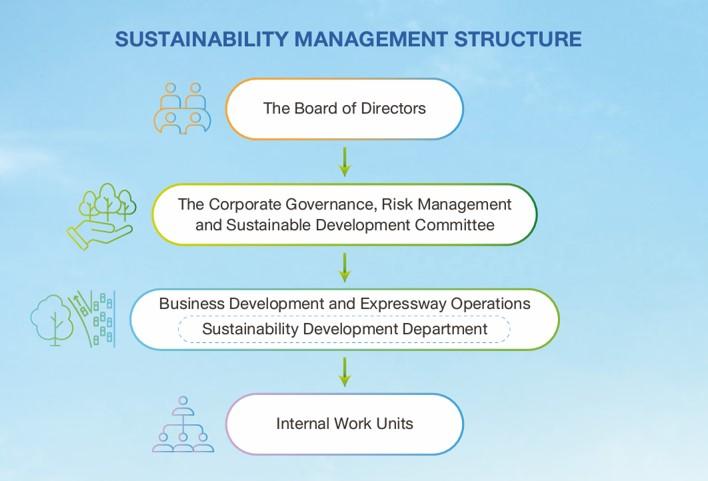
The Board of Directorsis responsible for establishing guidelines and approving the Corporate Social Responsibility and Sustainable Development Policy, together with monitoring the performance of such policy to ensure that the Company has continuously developed and improved its operational efficiency, as well as creating communication with stakeholder groups, namely customers, employees, society and communities, including relevant stakeholders so as to enable the Company to achieve its corporate sustainability performance goals, covering governance and economic, social and environmental dimensions. To this aim, the Corporate Governance, Risk Management and Sustainable Development Committee is then appointed to be responsible for supervising and reviewing the overall sustainability management and sustainability strategies of the Company to ensure consistency with the Corporate Social Responsibility and Sustainable Development Policy, by designating the Management Team as the policy executor, as well as reviewing or evaluating the sustainability performance to ensure compliance with the business strategies and goals, along with the expectations of stakeholders, including the changing circumstances, together with monitoring the implementation of such matters on a regular basis.
The Corporate Governance, Risk Management and Sustainable Development Committeeis responsible for considering action plans regarding sustainability management and stakeholder management in association with the Management Team to be submitted to the Board of Directors; supervising and reviewing the overall sustainability management and sustainability strategies of the Company to ensure consistency with the Company’s Corporate Social Responsibility and Sustainable Development Policy, as well as providing advice and recommendations on the corporate sustainability management while also promoting and supporting the continuous improvement and development of sustainability management, with the report on the organization’s sustainability materiality issues to the Board of Directors; following up on and evaluating the performance under sustainability management action plans, including the results of stakeholder management. The meeting is scheduled every quarter.
Business Development and Expressway Operation by the Sustainability Development Department is in charge ofcreating, overseeing, and developing the Company’s sustainability management process as well as coordinating and collaborating with the Company’s internal work units in driving the organization towards sustainability together. To this end, the information is prepared and submitted to the Corporate Governance, Risk Management and Sustainable Development Committee on a quarterly basis.
Policy Document Link
https://www.bemplc.co.th/CorporatePolicy?lang=en
Page Number in Report
5
Sustainability Goals & UN SDGs
Has Sustainability Goals
Yes
Goals Description
The Company has reviewed its sustainability operating framework to set the organization’s sustainability goals for the period 2023 - 2030, covering long-term strategic planning. The Company’s sustainability operations framework is as follows:
Mobility for All : Sharing the Sustainable Journey
B (Business Excellence and Ethics) | E (Eco-Friendly Commute) | M (Metropolitan Social Harmony) |
Business Excellence and Ethics | Eco-Friendly Commute | Metropolitan Social Harmony |
To be a driving force for economic growth for everyone through providing excellent, safe, and reliable transportation services. | To be a journey that uses resources efficiently, without causing pollution, while also maintaining a sustainable environment for the next generations. | To be a destination for building relationships among people in the metropolis with care and respect for each other. |
Goals:
| Goal:
| Goal:
|
In 2025, the Company has set clear goals to prioritize sustainability in 3 dimensions: i.e., Governance and Economic, Environmental and Social. This is a response to the Sustainable Development Goals (SDGs) of the United Nations, as outlined below:
SDGs | Governance and Economic B - Business Excellence and Ethics | Goals/Targets |
|
| 0 case |
|
| 100% |
|
| 100% 100% |
|
| 98% |
|
| 0 case |
SDGs | Environment E - Eco-Friendly Commute | Goals/Targets |
|
| Net Zero |
|
| 0 case |
|
| 100% |
SDGs | Social M - Metropolitan Social Harmony | Goals/Targets |
|
| 0 case 0 case 0 0 < 0.01 0 |
|
| 75% |
|
| 98% ≤ 0.1 communities/ |
|
| 100% |
|
| 0 case 100% |
Note: 1/Lost-Time Injury Frequency Rate means work-related injury that causes an employee to be unable to perform his/her normal duties for at least one full day or one full shift after the date of the incident.
UN Sustainable Development Goals
| SDG Goal |
|---|
| Goal 3 Good Health and Well-being |
| Goal 4 Quality Education |
| Goal 5 Gender Equality |
| Goal 6 Clean Water and Sanitation |
| Goal 7 Affordable and Clean Energy |
| Goal 8 Decent Work and Economic Growth |
| Goal 9 Industry, Innovation and Infrastructure |
| Goal 10 Reduce Inequalities |
| Goal 11 Sustainable Cities and Communities |
| Goal 12 Responsible Consumption and Production |
| Goal 13 Climate Action |
| Goal 15 Life on Land |
| Goal 16 Peace, Justice and Strong Institutions |
Policy Review
Policy Reviewed This Year
Yes
Policy Changed This Year
Yes
Review Details
The Company reviews its sustainability management policies and/or targets every three years, or when there is a significant change in the business context, with coordinated implementation to ensure consistency at both the management level and the Board level.
In 2025, the Company revised its organizational sustainability management target in the environmental dimension by setting a single key target, namely: achieving net-zero greenhouse gas emissions (Net Zero) by 2050, which is 15 years earlier than the previous target, in order to align with Thailand’s Net Zero target, which has also been accelerated by 15 years from 2065 to 2050. In addition, the Company reviewed its environmental practices to ensure comprehensive coverage in line with the disclosure criteria under the Annual Report (Form 56-1 e-One Report).
Business Value Chain
Value Chain Description
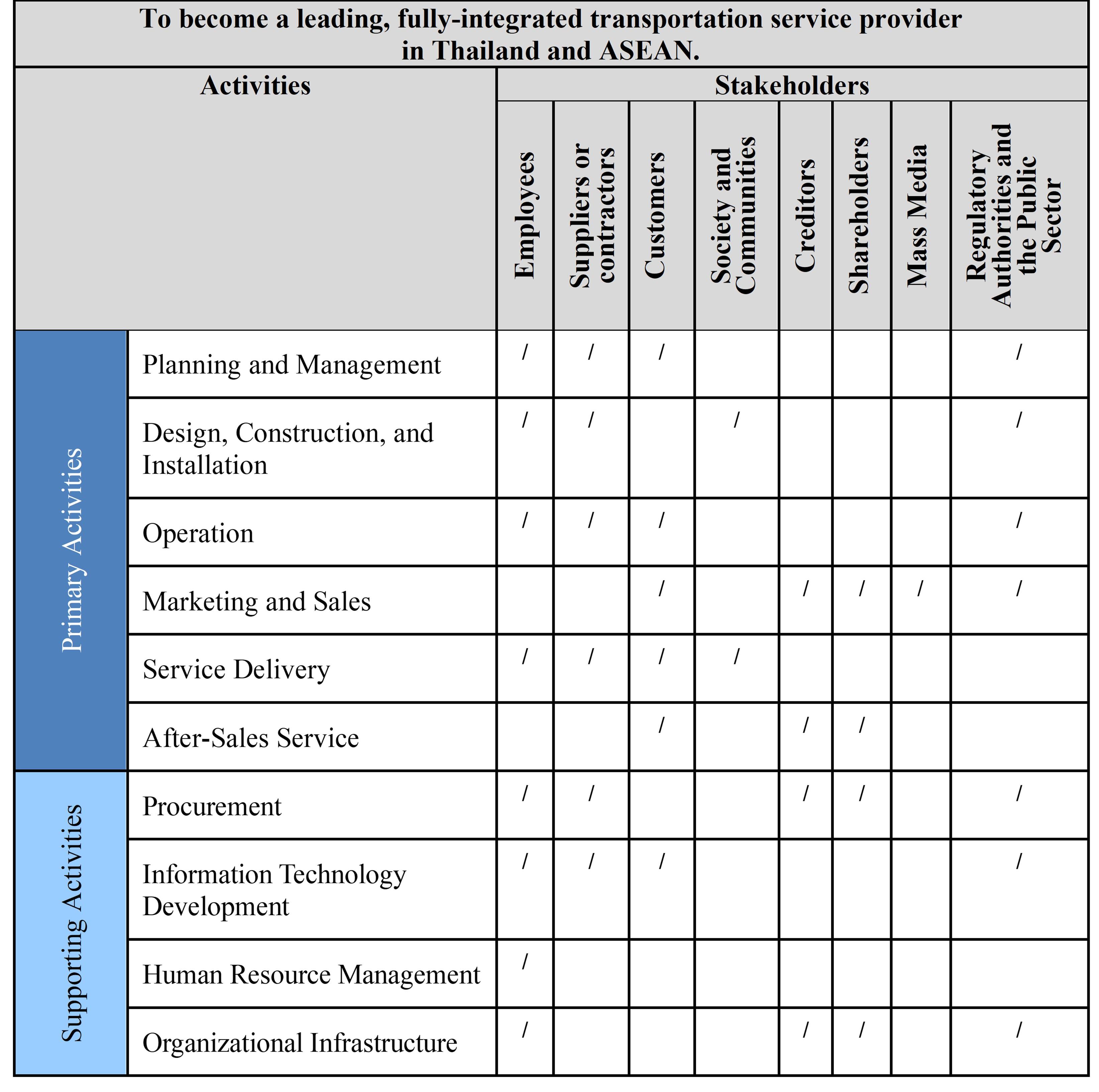
The Company is committed to becoming the leader in the provision of comprehensive transportation services for the country and the ASEAN region, by enhancing the quality and efficiency of the country’s transportation system while simultaneously raising the people’s quality of life to be comfortable, secure, and stable, in respect of expressways, metro systems, and commercial development in accordance with the principles of good governance, and thereby making it ready to take care of society and the environment through the Company’s activities, namely 6 primary activities, from the stages of planning and construction to the delivery of services, and 3 supporting activities. The relationships between each activity and each stakeholder group are as follows:
Stakeholder Analysis
Introduction
The Company is committed to sustainability management and places importance on continuously engaging with stakeholder groups connected to the Company’s businesses, including employees, who form a key foundation for the Company’s development; suppliers and contractors, who serve as business alliances; customers, to whom the Company aims to deliver quality services and enhance satisfaction; as well as society and communities with whom the Company coexists. In addition, the Company places importance on creditors, shareholders, mass media, and regulatory authorities and the public sector, which are responsible for the oversight and supervision of the Company, in order to strengthen trust and transparency in business operations for sustainable growth. The Company classifies its stakeholders into eight groups, namely: employees; suppliers or contractors; customers; society and communities; creditors; shareholders; mass media; and regulatory authorities and the public sector.
The Company recognizes the importance of cooperation and interconnections among stakeholders of all groups, which are fostered through effective management and the delivery of sustainable outcomes. The cooeration and interconnections will be beneficial to skaeholders of all groups and help build robust relationships. In addition, the Company is receptive to stakeholders’ comments and suggestions, including their expectations across the economic, social, and environmental dimensions so that the Company can adjust its operational plans to better respond to the expectations of each stakeholder group, enhance opportunities for stakeholders to strengthen their capabilities, minimize risks, and build a business ecosystem that creates positive impacts for stakeholders in all sectors.
Stakeholder Analysis
| Stakeholder Type | Stakeholders | Stakeholder Expectations | Response to Expectations | Communication Activities |
|---|---|---|---|---|
| Internal stakeholders | 2921 · Description: Employees | - Opportunities for growth and career advancement
- Appropriate and fair compensation and welfare
- Recognition of diversity and promotion of inclusion in the workplace
- Fair and equal treatment, including gender equality
- Appropriate development of employees’ potential, knowledge, and competencies
- Clear policies and operating guidelines, with organization-wide communication to ensure alignment in operations
- Occupational health and safety, and an appropriate working environment
- Assignment of challenging tasks that support employees’ capability development
- Encouragement of employee behaviors appropriately aligned with the corporate culture
- Strengthening employee engagement and pride in the Company
| - Defining the required competencies and attributes for job performance across all work units within the Company
- Establishing career paths for employees, together with a personnel development process to support self-development and achievement of targeted growth within the organization; providing mental health welfare, as well as loan and housing welfare
- Providing additional welfare based on recommendations of the Welfare Committee, as follows:
• Medical expense discounts for employees and their families with one additional partner hospital (bringing the total to three partner hospitals)
• Discounts on external fitness membership/services with one fitness center
- Providing nursing rooms, medical personnel, and medical supplies, as well as medicine refill service points, to ensure 24-hour coverage across all work areas
- Providing quadrivalent influenza vaccinations and health screening welfare, including screening for cervical cancer, breast cancer, and prostate cancer, to promote employees’ health
- Assigning a central unit to conduct additional drinking water quality testing, in addition to routine cleaning and periodic replacement of equipment under the regular maintenance cycle, on an annual basis covering all work areas, to enhance employees’ confidence in drinking water quality
- Providing marriage welfare inclusive of LGBTQIA+ employees, enabling equal access to marriage leave and marriage assistance payments
- Providing financial assistance to employees affected by natural disasters and human-induced incidents, such as floods, fires, windstorms, landslides, earthquakes, and tsunamis, etc.
- Collecting and compiling the Company-related news (Clipping News) and distributing it to executives and employees on a daily basis to ensure organization-wide communication of important information
| 2941 · Description: Online Communication · 2945 · Description: Complaint Reception · 2946 · Description: Employee Engagement Survey · 2948 · Description: Training / Seminar · 2949 · Other name: Employee engagement and happiness survey toward the organization: once per year · Description: Others · 2949 · Other name: Internal communications through various channels (both online and offline), including ongoing internal activities throughout the year · Description: Others · 2949 · Other name: Welfare Committee and management meetings: 4 times per year · Description: Others · 2949 · Other name: Ongoing employee grievance and feedback channels throughout the year · Description: Others · 2949 · Other name: Annual employee performance evaluation: once per year · Description: Others · 2949 · Other name: Quality Management System Committee meetings: 4 times per year · Description: Others · 2949 · Other name: Receiving complaints and feedback via supervisors through the chain of command · Description: Others · 2949 · Other name: Orientation program for new employees · Description: Others · 2949 · Other name: - Needs assessment and feedback collection from employees and supervisors to support the development of appropriate learning programs aligned with job requirements · Description: Others |
| External stakeholders | 2899 · Description: Suppliers · 2918 · Description: Contractors | - Knowledge and understanding of sustainable development
- Enhancing operational quality improvement and fostering inter-organizational trust
- Long-term business relationships and sustainable business collaboration
- Compliance with contractual terms and fair agreements
- Timely payment for goods/services in accordance with the specified timeframe
- Transparent and auditable procurement processes
- Fair and equal treatment of all suppliers
- A safe working environment
- A Supplier Code of Conduct to serve as clear guidelines
| - Providing training and knowledge to suppliers on conducting business in accordance with the sustainable development guidelines
- Communicating the Supplier Code of Conduct to suppliers for their adoption as guidelines when doing business with the Company
- Considering and preparing fair contracts with all suppliers
- Making payments for goods/services between the contractual parties in accordance with the specified terms and timeframe (within 30-45 days after receipt of an invoice, or as otherwise agreed)
- Preparing knowledge materials for suppliers to raise awareness and promote operations relating to environmental, social and governance (ESG) matters
- Assessing the sustainability (ESG) performance of suppliers that directly do business with the Company (Tier 1 Suppliers) through the Self-Assessment Form
- Assessing sustainability-related risks of Significant Tier-1 Suppliers by the Company’s employees
| 2938 · Description: Visit · 2941 · Description: Online Communication · 2947 · Description: Satisfaction Survey · 2948 · Description: Training / Seminar · 2949 · Other name: Contract and coordination through online and offline channels, in both one-way and two-way formats, whenever there are joint activities, as appropriate · Description: Others · 2949 · Other name: Notification and disclosure of material information via the Company’s website under “Sustainability/BEM/Supply Chain Management”, including, for example: • Supply chain management policies and guidelines • Supply chain management strategies • Supplier management processes • Supplier Code of Conduct • Disclosure of targets and key performance indicators on supply chain management • Other related policies and guidelines · Description: Others · 2949 · Other name: Whistleblowing or complaint channels to the Chairman of the Audit Committee / Independent Directors / the Company Secretary · Description: Others · 2949 · Other name: Supplier registration channel via the Company’s website under “B2B with BEM/Procurement” · Description: Others · 2949 · Other name: Occupational safety training for suppliers who are required to work within the Company’s premises, in accordance with the annual training plan · Description: Others · 2949 · Other name: Annual supplier meeting, once per year, to provide knowledge on conducting business in accordance with the sustainable development guidelines, reiterate relevant policies, and receive feedback from suppliers · Description: Others · 2949 · Other name: Knowledge materials for suppliers to promote learning and raise awareness to encourage participation in supporting sustainability-related implementation: 2 times per year · Description: Others · 2949 · Other name: Online survey of supplier satisfaction and expectations: once per year · Description: Others · 2949 · Other name: Sustainability (ESG) implementation assessment of suppliers in accordance with the assessment plan for 2025 · Description: Others · 2949 · Other name: Notification of the assessment results to suppliers whose performance does not meet the criteria, together with recommendations for improvement in accordance with the Company’s specified criteria · Description: Others · 2949 · Other name: Monthly contractors’ safety committee meetings to exchange relevant information, updates, and feedback relating to operations · Description: Others |
| External stakeholders | 2923 · Description: Customers | - Reliable, punctual, and accessible services
- Appropriate pricing
- Provision of sustainable and environmentally friendly mobility alternatives that are of quality and safe, and delivered on a non-discriminatory basis
- Appropriate safeguarding and protection of service users’ personal data
- Access to accurate and prompt communications of necessary information to support decision-making
- Accurate, clear, and timely information disclosure
- Products and payment channels that meet customers’ needs
- Ability to resolve issues and provide assistance to customers appropriately and in a timely manner
| - Developing projects taking into account customers’ expectations to align services with their needs and enhance the service user experience
- Continuously conducting activities to strengthen customer relationships (e.g., privilege programs with business alliances, concert ticket giveaways, Happy Journey activities, etc.)
- Communicating travel-impacting information clearly and promptly so that service users can use such information for trip planning and decision-making
- Receiving feedback and complaints through the Company’s channels and taking corrective actions by coordinating with relevant work units appropriately and promptly
| 2940 · Description: Social Event · 2941 · Description: Online Communication · 2945 · Description: Complaint Reception · 2947 · Description: Satisfaction Survey · 2949 · Other name: Customer satisfaction, needs, and expectations surveys, and ongoing collection of service feedback throughout the year · Description: Others · 2949 · Other name: Ongoing customer relationship-strengthening activities throughout the year · Description: Others · 2949 · Other name: Ongoing collection of complaints and feedback through various channels throughout the year · Description: Others |
| External stakeholders | 2902 · Description: Community · 2928 · Description: Society | - Reduction of negative environmental impacts and enhancement of positive impacts on society and communities
- Local employment and income-generation opportunities
- Preparedness, establishment of safety measures, and emergency response
- Participation in and support for community activities
- Respect for communities’ fundamental rights
- Promotion of cooperation and good relationships between communities and the Company
| - Implementing the strategic plan for the implementation of social and community engagement (development framework for 2025 - 2028) under the sustainability framework, and conducting society and community relationship-building activities as planned
- Receiving feedback and complaints through the Company’s channels and addressing them by coordinating with relevant work units appropriately and promptly
| 2938 · Description: Visit · 2940 · Description: Social Event · 2945 · Description: Complaint Reception · 2947 · Description: Satisfaction Survey · 2949 · Other name: Ongoing collection of feedback and complaints through the Company’s channels throughout the year · Description: Others · 2949 · Other name: Ongoing meetings, discussions, and visits with communities affected by the Company’s business operations to strengthen relationships with the communities throughout the year · Description: Others · 2949 · Other name: Continuous social and environmental benefit activities in areas surrounding the expressways and mass transit routes throughout the year · Description: Others · 2949 · Other name: Community satisfaction or engagement assessment on an activity-by-activity basis · Description: Others |
| External stakeholders | 2894 · Description: Creditor · 2904 · Description: Investors or investment institutions · 2905 · Description: Analysts · 2925 · Description: Financial institution | - The Company’s stable operating performance and future investment plans for sustainable growth
- Appropriate risk management and financial liquidity management
- Accurate, transparent, and reliable financial reporting and auditing
- Compliance with terms and conditions of loan agreements and debentures
| - Preparing MD&A and the Annual Report (Form 56-1 One Report), as well as disclosing performance and relevant information through the Stock Exchange of Thailand and the Company’s Investor Relations webpage accurately, completely, and in a timely manner
- Submitting financial statements to lending institutions, the SEC Office, and ThaiBMA, and completely complying with terms and conditions of loan agreements and debentures
- Participating in SET Opportunity Day (4 times) and holding Analyst Meetings (4 times)
- Conducting investor and analyst engagement and communication through one-on-one meetings, company visits, and events organized by the SET and securities companies (totaling 28 times)
- Conducting an investor relations service satisfaction survey, achieving a satisfaction score of 93.02%, which exceeded the target of 90%
| 2949 · Other name: Disclosures in accordance with requirements of the SEC Office and the SET (e.g., MD&A 4 times/year and the Annual Report (Form 56-1 One Report)) · Description: Others · 2949 · Other name: Monthly information updates via the Company’s website on the Investor Relations webpage · Description: Others · 2949 · Other name: Submission of financial statements and related information in accordance with the terms and conditions of loan agreements and debentures · Description: Others · 2949 · Other name: Ongoing presentation of the Company’s operating performance through on-site and online meetings throughout the year · Description: Others |
| External stakeholders | 2913 · Description: Shareholders | - Business operations in compliance with applicable requirements and laws, with transparency, environmental and social responsibility, and due regard to the Company’s sustainable growth
- Fair and equitable treatment of investors and shareholders
- Accurate, transparent, complete, and timely disclosure of information in compliance with the rules of the SET, with regular and continuous communication with shareholders
- Expanding sustainable business opportunities and securing investment budgets for new projects while maintaining financial stability, profitability, and the ability to generate appropriate returns on investment
| - Supervising operations to ensure compliance with applicable requirements, laws, official announcement, concession agreements, and other business-related obligations with transparency, fairness, environmental responsibility, and auditability
- Organizing shareholder meetings in an online format, placing emphasis on responding to shareholders’ questions during meetings while enabling shareholders to propose agenda items, nominate candidates for director selection, and submit questions in advance via the Company’s website
- Presenting the Company’s operating performance through various activities both domestically and internationally
- Preparing regular reports to disclose information and communicate the Company’s operating performance, including the Annual Report (Form 56-1 One Report) and MD&A
- Establishing a clear dividend payment policy
- Setting a clear growth strategy framework with a focus on core businesses in which the Company has experience and expertise
- Co-investing with the public sector in transport system projects to create the Company’s next growth wave, by selecting only projects with appropriate returns consistent with the Company’s capabilities
- Enhancing operational efficiency and reducing costs through the adoption of technology in toll collection and fare collection systems, together with efficient financial cost management
| 2944 · Description: Annual General Meeting (AGM) · 2949 · Other name: Holding the Annual General Meeting of Shareholders (AGM) once per year, and an Extraordinary General Meeting of Shareholders (EGM) when urgent necessity arises, while providing opportunities for shareholders to: • Ask questions or express opinions at the meetings, and submit questions in advance •Vote on the appointment of directors on an individual basis, including exercising voting rights to remove directors at shareholders’ meetings • Exercise shareholder rights fairly and equally to propo · Description: Others · 2949 · Other name: Information disclosure and performance communications through various channels: • Form 56-1 One Report: once per year • MD&A: four times per year via the SET and the Company’s website • Shareholder engagement channels and activities, such as Company Visits and corporate communications activities, to support ongoing communication and engagement throughout the year • Ongoing communications with shareholders through the Company’s channels, such as the website, e-mail, and telephone, annually · Description: Others |
| External stakeholders | 2929 · Description: Media | - Access to continuous updates and information regarding the Company’s operations, including marketing activities undertaken by the Company
- Progress updates and developments of key projects currently under implementation
- Comments and recommendations in the Company’s capacity as a public transport operator
- The Company’s responsibility toward society, the environment, and operations in accordance with the principles of corporate governance
- Accurate, transparent, and timely disclosure of information, including appropriate and timely clarification of causes, impacts, and mitigation approaches in the event of any abnormal incidents
| - Regularly prepare and distribute the Company press releases in various formats to share topics of interest and continuously communicate material information to the mass media, such as business updates, operating performance, and social, community, and environmental activities, etc.
- Inviting the mass media to participate in activities (e.g., press conferences and marketing events) and providing complete and clear information on relevant matters
- Promptly issuing news releases or information to clarify the situation in the event of abnormal incidents, so that the mass media receives accurate, complete, and timely information
| 2938 · Description: Visit · 2939 · Description: Press Release · 2949 · Other name: Media coordination throughout the year, and dissemination of information regarding the Company’s operations, marketing activities, and corporate social responsibility (CSR) activities through various online and offline media channels, such as websites, social media, newspapers, television, and radio · Description: Others · 2949 · Other name: Preparing and distributing publicity materials, namely: press releases, news photos, scoop news, video clips, and radio spots · Description: Others · 2949 · Other name: Organizing special activities (e.g., press conferences and special interviews) at least once per year to communicate an overview of the Company’s operating performance · Description: Others · 2949 · Other name: Press visit on appropriate occasions (e.g., the organization’s anniversary and New Year season, etc.) · Description: Others |
| External stakeholders | 2931 · Description: Government agencies and Regulators | - Compliance with laws and regulations, and reporting of inspection and control results as specified under concession agreements
- Implementation of safety and security measures certified under international standards
- Efficient management and delivery of the country’s transport infrastructure services in accordance with international service standards
- Cooperation and support for initiatives that benefit the public interest
- Conducting the businesses in compliance with applicable requirements, laws, and regulations
- Sustainable business collaboration that is transparent and auditable
- A safe working environment
| - Strictly complying with applicable laws, regulations, rules, concession agreement requirements, and other relevant conditions relating to business conduct
- Holding meetings with government agencies that are project owners for each project and/or attending discussions upon invitation by government agencies on specific matters
- Engaging in discussions with government agencies and regulatory authorities to receive recommendations and provide constructive opinions
- Monitoring changes in relevant laws and regulations to ensure compliant and accurate implementation
- Disclosing information and cooperating with government regulatory agencies accurately, completely, and within the specified timeframe
- Participating in inter-organizational relationship-strengthening activities, such as:
• Sports activities to foster good relationships between the organizations’ executives and employees
• Tree-planting activities for an environmental awareness campaign jointly with regulatory authorities and the public sector
• Supporting activities to promote safety for expressway users and MRT passengers
| 2943 · Description: External Meeting · 2947 · Description: Satisfaction Survey · 2949 · Other name: Reporting performance and operations to relevant regulatory authorities and the public sector on a monthly, quarterly, and annual basis · Description: Others · 2949 · Other name: Monthly assessment of satisfaction regarding operational performance · Description: Others · 2949 · Other name: Full compliance with applicable rules and regulations · Description: Others · 2949 · Other name: Ongoing participation in government activities and projects, including continuous collaboration on relevant matters · Description: Others · 2949 · Other name: Case-by-case meetings with government agencies on a monthly basis, or upon invitation by government agencies to discuss specific matters · Description: Others |
Environmental Sustainability — Overview
Introduction
The Company is committed to conducting its businesses with environmental responsibility and taking into account environmental impacts, in alignment with the Company’s mission and sustainability policy to operate the businesses based on sustainability principles. Accordingly, the Company has established the Environmental and Climate Policy and practices to ensure efficient and effective environmental performance in alignment with international principles and standards on a continuous basis, such as ISO 14001. This Environmental and Climate Policy covers all operational processes. It is the responsibility of all employees and contractors of the Company to implement the policy in a serious and consistent manner. The Company also has an environmental complaint management process, with channels for receiving environmental feedback, such as via telephone and e-mail through the Information Service Center, via employees and QR codes within MRT stations, through social media, and other channels, etc.
Environmental Policy & Guidelines
Has an Environmental Policy
Yes
Policy Description
(1) Environmental and Climate Policy
The Company conducts business with strong adherence to the social and environmental responsibility, leading to our commitment to continuously developing environmental and climate change management systems in accordance with international principles and standards for sustainability. This encompasses activities related to the company's stakeholders by the following :
Integrate environmental awareness programs and sustainable resource management strategies into our operations to protect the environment.
Prevent and control the environmental pollutions generated from the business activities to minimize the environmental impacts and climate change to as low as reasonably practicable, and aiming for net zero greenhouse gas emission.
Employ effective and efficient sourcing, selection, and resource management measures, including proactive prevention and control strategies, to minimize environmental impact and maximize resource utilization for sustainable operations.
Ensure that the business complies with all applicable laws and environmental regulations.
Ensure that the environmental and climate change management systems are regularly reviewed and continuously improved to remain consistent and adaptive to business context, materiality issue and changing circumstances. This includes protecting and preserving biodiversity and ecosystems.
Communicate the environmental and climate change policy, guidelines, and management practices to staff and key suppliers, promoting knowledge, awareness, and participation throughout the value chain. communities.
All employees, contractors, suppliers, and collaborators share responsibility for upholding this Environmental and Climate Policy, ensuring a healthy environment for everyone across our value chain, including our customers, employees, stakeholders, and the surrounding
(2) Environmental Practices
The Company conducts its businesses with a commitment to social and environmental responsibility and is therefore committed to continuously developing its environmental and climate change management system in accordance with international principles and standards to support sustainable business growth. The Company has established overall practices and specific practices covering stakeholders throughout the business value chain, as follows:
Overall Practices
Life Cycle Assessment: Assessing the life cycle of significant products and services to identify resource use, sources of resources, energy consumption, and all forms of waste and pollution emissions, covering all stages of production and service delivery, including the care and management of resulting waste and pollution.
Context and Impact Analysis: Regularly reviewing and analyzing both internal and external contexts to identify opportunities, environmental and climate change impacts, as well as significant environmental issues that may severely affect business operations.
Compliance with Laws and Requirements: Strictly adhering to applicable laws, the Company’s requirements, international standards, commitments, and policies relating to environmental management.
Risk Management: Identifying and assessing environmental and climate change risks, and establishing risk management measures, risk indicators, risk appetite, and risk tolerance to control risks at an appropriate level and protect the environment effectively.
Setting Objectives and Strategies: Establishing clear objectives, strategies, indicators, and targets relating to environmental and climate change matters, together with action plans for the short, medium, and long term.
Integration into Work Processes: Integrating environmental risks, opportunities, and strategies into the Company’s management and work processes, and communicating and cascading them to ensure concrete implementation across the organization.
Monitoring and Evaluation: Monitoring, supervising, and evaluating the efficiency and effectiveness of environmental operations on a regular basis, using results to consider continuous improvement and development in response to changing circumstances.
Defining Roles and Responsibilities: Clearly defining the scope, duties, and responsibilities of executives and employees at all levels, from management and operations to supervision, monitoring, analysis, and reporting.
Stakeholder Engagement: Communicating, raising awareness, and promoting stakeholder engagement throughout the Company’s value chain to drive environmental performance toward shared targets.
Promoting Environmentally Friendly Products and Services: Establishing policies for selecting and promoting the use of environmentally friendly products and services in business operations.
Specific Practices by Area
Electricity Energy Management: Placing importance on managing electricity, which is a key resource for the Company’s business operations. The Company is committed to reducing electricity consumption generated from fossil fuels by improving work processes, systems, and equipment to enhance efficiency, and by selecting energy-saving equipment across all areas, including service areas, operational areas, and office buildings, e.g., electrical and lighting systems, air-conditioning systems, and ventilation systems. In addition, the Company promotes awareness to encourage behavioral changes among employees to achieve tangible energy conservation.
Fuel and Oil Management: Focusing on improving and modifying machinery and equipment, as well as enhancing operating processes, to reduce oil and fuel consumption while maintaining the highest standards of service quality and safety.
Renewable and Clean Energy Management: Promoting the use of renewable energy by continuously increasing the proportion of clean energy consumption, such as installing solar power generation systems to replace electricity generated from fossil fuels, and transitioning to electric vehicles to replace oil-fueled vehicles.
Water Resources and Water Quality Management: Managing water resources for maximum efficiency by applying technology in system design and equipment modifications to reduce water consumption, and by implementing water recycling systems to reduce reliance on natural water sources, including treating, monitoring, and controlling the quality of wastewater generated from the Company’s activities to meet legal standards prior to discharge to the public environment.
Garbage and Waste Management: Applying the 3Rs principle to systematic waste management, as follows:
Reduce: Reducing waste at the source by using resources only as necessary and avoiding excessive consumption.
Reuse: Promoting reuse to extend the useful life of items and reduce waste volume.
Recycle: Managing waste segregation efficiently so that various waste types enter recycling and recovery processes for beneficial reuse, while ensuring accurate and proper management of organic waste and hazardous waste in accordance with applicable laws and regulations.
Biodiversity Management: Having a step-by-step biodiversity management process in place, from identification and assessment to the determination of impact mitigation measures, together with planning and implementation for the conservation, protection, and restoration of biodiversity within ecosystems relevant to its business operations.
Greenhouse Gas Management and Climate Change: Being committed to seriously managing and reducing greenhouse gas emissions by establishing the short-, medium-, and long-term greenhouse gas reduction targets to achieve Net Zero by 2050, in accordance with the Science Based Targets initiative (SBTi) approach, and implementing various projects to achieve the established targets.
Air Quality Management: Managing air quality impacts arising from the Company’s business operations by designing and improving relevant system structures and installing equipment to reduce air-related impacts on communities and society. The Company also regularly monitors ambient air quality around its operational areas to ensure compliance with applicable standards.
Noise Pollution Management: Managing operational noise through the design and upgrading of structures and systems, as well as the installation of equipment to control noise at the source and along transmission pathways. In addition, the Company regularly measures noise levels along and around the routes to mitigate impacts on surrounding communities and society.
Policy Document Link
https://www.bemplc.co.th/CorporatePolicy?lang=en
Page Number in Report
5
Environmental Guidelines
| Guideline |
|---|
| Electricity Management |
| Fuel Management |
| Renewable/Clean Energy Management |
| Water Management |
| Waste Management |
| Biodiversity Management |
| Greenhouse Gas and Climate Change Management |
| Air Quality Management |
| Noise Pollution Management |
Environmental Policy Review
Introduction
The Company regularly reviews environmental policies, performance reporting, and relevant environmental issues at the management level with the Quality Management System Committee and the Safety Committee in order to improve practices and identify preventive and corrective measures for environmental issues that arise. In addition, the Company communicates through various channels to raise awareness within the Company, as well as among contractors and suppliers involved in environmental matters, on a regular basis.
In 2025, the Company reviewed and improved its environmental practices, both the overall practices and the specific practices by area, to provide greater clarity. Such environmental practices were submitted to and approved by the Corporate Governance, Risk Management and Sustainable Development Committee, and have been published in the Corporate Governance Handbook on the Company’s website.
Policy Reviewed This Year
Yes
Energy Management — Overview
Introduction
The Company operates expressway services and mass transit services (electric rail systems), which are energy-intensive businesses primarily reliant on electricity and oil-based fuels. The Company therefore recognizes and places importance on high-level energy management through operational plans and efficient resource management approaches, while building awareness of climate change by promoting employee engagement and applying modern technologies to support energy management. This enables comprehensive sustainability development across all elements throughout the value chain.
Energy — Plan & Guidelines
Has an Energy Management Plan
Yes
Plan Description
The Company has established strategic plans and targets for energy management to achieve effective reductions in energy consumption. The Company has also established an Energy Management Working Team to oversee and implement energy reduction initiatives across various activities, such as fuel consumption reduction, transitioning from internal combustion engine vehicles to electric vehicles, replacing HPS lamps with LED, improving air-conditioning system efficiency, and installing solar power generation systems.
Plan Document Link
https://sustainability.bemplc.co.th/Climate?lang=en
Page Number in Report
Page 1
Energy — Electricity Consumption
Electricity Consumption
| Metric | Current Year | Previous Year | Two Years Ago |
|---|---|---|---|
| Total electricity consumption within the organization (Kilowatt-Hours) | 226,018,392.64 | 232,312,593 | 226,394,104 |
| Electricity purchased for consumption from non-renewable energy sources (Kilowatt-Hours) | 224,634,521.28 | 231,658,602 | 225,756,514 |
| Electricity purchased or generated for consumption from renewable energy sources (Kilowatt-Hours) | 1,383,871.36 | 653,991 | 637,590 |
Energy — Fuel Consumption
Fuel Consumption
| Metric | Current Year | Previous Year | Two Years Ago |
|---|---|---|---|
| Crude oil (Barrels) | 0 | 0 | |
| Coal (Metric tonnes) | 0 | 0 | |
| Jet fuel (Litres) | 0 | 0 | |
| Diesel (Litres) | 626,491.61 | 716,909.02 | 700,023 |
| Gasoline (Litres) | 14,837.4 | 24,164.46 | 42,836 |
| Fuel oil (Litres) | 0 | 0 | |
| Natural gas (Standard cubic feet) | 0 | 0 | |
| LPG (Kilograms) | 3,558 | 3,352 | 3,661 |
| Steam (Metric tonnes) | 0 | 0 |
Energy — Targets
Introduction
The Company has set a target to reduce the energy consumption of electricity and/or oil and fuel by ≥ 4% compared with the previous year, or ≥ 4% per year, using 2023 as the base year.
Has Set Targets
Yes
Targets
| Target | Base Year | Base Year Value | Target Year | Target Change (%) | Unit |
|---|---|---|---|---|---|
| Reduction of electricity purchased for consumption | 2,023 | 225,756,514.3 | 2,025 | 8 | Kilowatt-hour |
| Reduction of fuel consumption | 2,023 | 7,506,648.8 | 2,025 | 8 | Kilowatt-hour |
| Reduction of electricity purchased and fuel consumption | 2,023 | 233,263,165.48 | 2,025 | 8 | Kilowatt-hour |
Energy — Performance & Outcomes
Has Performance Results
Yes
Performance Description
Overall, in 2025, the company implemented a total of 10 energy management projects with an investment budget of approximately Baht 46.14 million. the company was able to reduce energy costs by Baht 5.98 million, reducing total energy consumption by 1,000,159 kWh, renewable energy production by 226,644 kWh, reduce fuel use by a total by 39,682 liters and reduce greenhouse gas emissions by 710.87 tCO2e. In addition, the Company received energy-related awards at the national and regional levels, as follows:
Thailand Energy Awards 2025 – Outstanding Award for Energy Conservation in the Controlled Building Category, organized by the Ministry of Energy to recognize organizations with outstanding achievements in energy conservation. This prestigious award is granted to organizations demonstrating strong commitment to systematic energy management and the development and implementation of projects that enhance energy efficiency while sustainably reducing environmental impacts.
ASEAN Energy Awards 2025 – Second Runner-up, under the ASEAN Energy Efficiency and Conservation Best Practices Awards 2025, category ASEAN Best Practices Competition for Energy Management in Buildings and Industries, awarded at the ASEAN Energy Awards (AEA) 2025. This regional award recognizes organizations with outstanding performance in sustainable energy development and conservation, covering three main areas: Renewable Energy (RE), Energy Efficiency and Conservation (EE&C), and Clean Coal Technology (CCT). The award aims to promote and honor organizations with innovations that advance regional energy security and support the achievement of the ASEAN Plan of Action for Energy Cooperation (APAEC).
Water Management — Overview
Introduction
The Company is committed to water management from upstream sourcing, ensuring that clean, safe, and sufficient water is available for business operations. The Company applies water conservation principles, promotes efficient water reuse within its operations, and manages wastewater in accordance with applicable standards prior to discharge to the public drainage system, without adverse environmental impacts, in line with ISO 14001.
The Company uses water supplied by public water utilities, namely: the Metropolitan Waterworks Authority (MWA) and the Provincial Waterworks Authority (PWA), and also uses groundwater in certain areas. The Company does not withdraw water from water-stressed areas. In addition, the Company reuses water in various activities, such as water recycling systems at electric train washing facilities and reusing treated wastewater for watering trees around office buildings.
Water — Plan & Guidelines
Has a Water Management Plan
Yes
Plan Description
The Company has established operational guidelines and procedures for water management by preparing a water management plan, assessing volumes of tap water consumption and reused effluent, and evaluating the effectiveness of projects or measures implemented for water management. The Company continuously raises awareness and promotes water conservation among employees through campaign materials and signage. The Company also regularly inspects and improves water-use equipment to maintain efficiency and keeps detailed records of water consumption to facilitate water planning and management.
Plan Document Link
https://sustainability.bemplc.co.th/Environment?lang=en
Page Number in Report
Page 1
Water — Withdrawal, Discharge & Consumption
Water Withdrawal, Discharge & Consumption
| Metric | Current Year | Previous Year | Two Years Ago |
|---|---|---|---|
| Total water withdrawal (Cubic meters) | 656,327 | 794,584 | 653,162 |
| Total water withdrawal by third-party water (Cubic meters) | 656,327 | 794,584 | 653,162 |
| Total water withdrawal by surface water (Cubic meters) | |||
| Total water withdrawal by groundwater (Cubic meters) | |||
| Total water withdrawal by seawater (Cubic meters) | |||
| Total water withdrawal by produced water (Cubic meters) | |||
| Percentage of wastewater treated before discharge (%) | |||
| Total water discharge (Cubic meters) | 656,327 | 794,584 | 653,162 |
| Total water discharge to third-party water (Cubic meters) | 603,548 | 745,176 | 603,381 |
| Total water discharge to surface water (Cubic meters) | 52,779 | 49,408 | 49,781 |
| Total water discharge to groundwater (Cubic meters) | |||
| Total water discharge to seawater (Cubic meters) | |||
| Total water consumption (Cubic meters) | 0 | 0 | 0 |
| Recycled water (Cubic meters) | 5,739 | 6,698 | 5,610 |
Water — Targets
Introduction
Using 2023 as the base year, the Company has set a target to control water consumption so that it does not exceed the previous year or a water consumption reduction target of ≥ 0% compared with the previous year, or ≥ 0% per year.
Has Set Targets
Yes
Targets
| Target | Base Year | Base Year Value | Target Year | Target Change (%) | Unit |
|---|---|---|---|---|---|
| Reduction of water withdrawal | 2,023 | 653,162 | 2,025 | 0 | Cubic meters |
Water — Performance & Outcomes
Has Performance Results
Yes
Performance Description
In 2025, the Company’s number of service users increased, resulting in higher water consumption. Consequently, the Company was unable to achieve the established target. In this regard, the Company recorded a total water consumption of 656,327.00 m3, a total reused water of 5,739.00 m3, and a total wastewater discharged externally of 656,327.00 m3.
Waste Management — Overview
Introduction
The Company is committed to managing garbage and waste by reducing waste generation at the source, based on the 3R principle: Reduce, Reuse, and Recycle. In addition, the Company promotes environmental awareness and personnel participation to enhance knowledge and understanding of the waste management process, including collection and segregation into the following categories: general waste, biodegradable waste, hazardous waste, infectious waste, and recyclable waste. This helps reduce the amount of waste, maximize resource utilization, and reduce costs arising from waste disposal processes. Moreover, some municipal garbage and waste that remains usable can be reused, such as through the production of bio-fertilizer. At present, waste generated from the expressway business, rail system business, and commercial development business is managed through an effective process that is consistent with the ISO 14001 international standard, in order to prevent potential environmental impacts.
Waste — Plan & Guidelines
Has a Waste Management Plan
Yes
Plan Description
The Company has established strategic plans and targets for garbage and waste management. The Company initiated the Green Office Project at the Rama 9 Administration Building as the first site, serving as a model for environmental management in buildings, and plans to expand the implementation to other offices in the future. In addition, the Company has set action plans and targets to reduce general waste generated by passengers in the retail-floor areas, as well as general waste generated by employees in the office areas of BMN, a subsidiary engaged in commercial development business. The Company has also continuously implemented various waste management projects, such as the “1 Cap, 1 Dream for Prosthetic Legs” Project and the “Send Plastics Back Home” Project, to reduce waste generation at the source and to maximize the utilization of waste from both production processes and various activities.
Plan Document Link
https://sustainability.bemplc.co.th/Environment?lang=en
Page Number in Report
Page 1
Waste — Generation, Disposal & Recycling
Waste Generation, Disposal & Recycling
| Metric | Current Year | Previous Year | Two Years Ago |
|---|---|---|---|
| Total waste generated (Kilograms) | 1,157,906.36 | 1,064,375.16 | 833,603 |
| Non-hazardous waste (Kilograms) | 1,059,423.36 | 967,912.66 | 758,603 |
| Non-hazardous waste - Landfilling (Kilograms) | 1,012,243.16 | 954,336.86 | |
| Non-hazardous waste - Incineration (with energy recovery) (Kilograms) | |||
| Non-hazardous waste - Incineration (without energy recovery) (Kilograms) | |||
| Non-hazardous waste - Other disposal operations (Kilograms) | 47,180.2 | 13,575.8 | |
| Hazardous waste (Kilograms) | 98,483 | 96,462.5 | 75,000 |
| Hazardous waste - Landfilling (Kilograms) | |||
| Hazardous waste - Incineration (with energy recovery) (Kilograms) | 29,923 | 4,944 | |
| Hazardous waste - Incineration (without energy recovery) (Kilograms) | |||
| Hazardous waste - Other disposal operations (Kilograms) | 68,560 | 91,518.5 | |
| Total reused/recycled waste (Kilograms) | 115,740.2 | 32,467.75 | 44,348 |
| Reused/Recycled non-hazardous waste (Kilograms) | 47,180.2 | 32,467.75 | 31,948 |
| Reused non-hazardous waste (Kilograms) | 23,330.8 | 13,575.8 | 12,238 |
| Recycled non-hazardous waste (Kilograms) | 23,849.4 | 18,891.95 | 19,710 |
| Reused/Recycled hazardous waste (Kilograms) | 68,560 | 12,400 | |
| Reused hazardous waste (Kilograms) | |||
| Recycled hazardous waste (Kilograms) | 68,560 | 12,400 |
Waste — Targets
Introduction
The Company has set a target to reduce the amount of garbage and waste generated by ≥ 4% compared with the previous year, or ≥ 4% per year, using 2023 as the base year.
Has Set Targets
Yes
Targets
| Waste Type | Disposal Approach | Target | Base Year | Base Year Value | Target Year | Target Change (%) | Unit |
|---|---|---|---|---|---|---|---|
| Non-hazardous waste | 2758 · Description: Reuse · 2759 · Description: Recycle · 2760 · Description: Landfilling · 2763 · Description: Other | Reduce waste volume | 2,023 | 833,603 | 2,025 | 8 | Kilograms |
Waste — Performance & Outcomes
Has Performance Results
Yes
Performance Description
The Company carries out activities to reduce waste generated across various areas of the Company, including office areas and operational areas, e.g., MRT stations, through cooperation with employees and customers, as well as external organizations, in a variety of activities and formats. In addition to raising awareness among the Company’s employees, the objective is also to manage garbage and waste as efficiently as possible, ensuring that each type of garbage and waste is treated and disposed of properly and appropriately, resulting in the creation of value and the reduction of costs arising from disposal processes while reducing the amount of non-hazardous waste sent to landfills. Furthermore, the Company has collected plastic waste to support environmentally friendly activities and has cooperated with its alliances to collect recyclable waste through the use of environmentally friendly electric vehicles for transportation.
In 2025, the total garbage and waste generated amounted to 1,157,906.36 kg, and the amount of garbage and waste recovered amounted to 115,740 kg, representing an increase from the previous year.
Greenhouse Gas — Overview
Introduction
The Company is committed to responding to the Paris Agreement and the United Nations Framework Convention on Climate Change Conference of the Parties (UNFCCC COP), the 26th Session (COP26), in order to limit the increase in global temperature to no more than 1.5oC. The Company has set a target of achieving net-zero greenhouse gas emissions by 2050, which is aligned with Thailand’s greenhouse gas emissions target.
GHG — Plan & Guidelines
Has a GHG Management Plan
Yes
Plan Description
The Company has established strategies, action plans, and targets for managing climate change and energy that cover activities throughout the business value chain, in order to achieve effective and aligned greenhouse gas emission reductions. The Company has established the Quality Management System Committee, the Safety Committee, and the Quality and Efficiency Management Committee to oversee quality and environmental management within the Company. In addition, the Company has established an Energy Management Working Team to oversee and implement greenhouse gas emission reduction and energy-use initiatives in various activities, such as fuel consumption, electricity consumption, water consumption, and paper consumption.
Plan Document Link
https://sustainability.bemplc.co.th/Climate?lang=en
Page Number in Report
Page1
GHG — Emissions
GHG Emissions
| Metric | Current Year | Previous Year | Two Years Ago |
|---|---|---|---|
| Total GHG emissions (Metric tonnes of carbon dioxide equivalent) | 135,790.09 | 141,552.14 | 143,834 |
| Total greenhouse gas emissions 1 (Metric tonnes of carbon dioxide equivalent) | 2,901.15 | 4,048.73 | 8,059 |
| Total greenhouse gas emissions 2 (Metric tonnes of carbon dioxide equivalent) | 105,182.66 | 108,781.17 | 106,364 |
| Total greenhouse gas emissions 3 (Metric tonnes of carbon dioxide equivalent) | 27,706.28 | 28,722.24 | 29,411 |
GHG — Emissions Verification
Emissions Verified by a Third Party
Yes
Verifying Body
2643
GHG — Principles & Standards
Introduction
The Company has defined its operational boundary under the Operational Control approach for all three scopes of greenhouse gas emissions and has established a process for setting science-based greenhouse gas emission reduction targets in accordance with the Science Based Targets initiative (SBTi). This begins with the calculation of the Company’s greenhouse gas emissions, using 2023 as the base year. The Company’s organizational greenhouse gas emissions data for 2023 across all three scopes were verified by an external verifier, TUV NORD (Thailand) Ltd., and the Company has registered the certification of its organizational greenhouse gas emissions with the Thailand Greenhouse Gas Management Organization (Public Organization) (TGO). For the base year 2023, the Company’s greenhouse gas emissions amounted to 143,834 tCO2e. The Company has jointly developed strategic plans with relevant internal units to set detailed greenhouse gas emission reduction targets.
Principles & Standards Applied
| Standard |
|---|
| 2671 |
GHG — Targets
Has Set GHG Targets
Yes
GHG Targets — Net Zero
Net Zero Targets
| Emission Scope | TGO Certification | Base Year | Base Year Emissions | Near-term Target Year | Near-term Target Value | Near-term Target Change (%) | Long-term Target Year | Long-term Target Value | Long-term Target Change (%) | Target Year | Target Year Emissions | Target Change (%) | Unit |
|---|---|---|---|---|---|---|---|---|---|---|---|---|---|
| 2717 | Net zero | 2,023 | 8,059 | 2,025 | 322.36 | 8 | 2,050 | 8,059 | 100 | 2,025 | 322.36 | 8 | Metric tonnes of carbon dioxide equivalent |
| 2718 | Net zero | 2,023 | 106,364 | 2,025 | 4,254.56 | 8 | 2,050 | 106,364 | 100 | 2,025 | 4,254.56 | 8 | Metric tonnes of carbon dioxide equivalent |
| 2719 | Net zero | 2,023 | 29,411 | 2,025 | 1,176.44 | 8 | 2,050 | 29,411 | 100 | 2,025 | 1,176.44 | 8 | Metric tonnes of carbon dioxide equivalent |
| 2716 | Net zero | 2,023 | 143,834 | 2,025 | 5,753.36 | 8 | 2,050 | 143,834 | 100 | 2,025 | 5,753.36 | 8 | Metric tonnes of carbon dioxide equivalent |
GHG Targets — Other Targets
Other GHG Targets
| Emission Scope | Base Year | Base Year Emissions | Near-term Target Year | Near-term Target Value | Near-term Target Change (%) | Long-term Target Year | Long-term Target Value | Long-term Target Change (%) | Target Year | Target Year Emissions | Target Change (%) | Unit |
|---|---|---|---|---|---|---|---|---|---|---|---|---|
| 2717 | 2,023 | 8,059 | 2,025 | 322.36 | 8 | 2,030 | 2,256.52 | 28 | 2,025 | 322.36 | 8 | Metric tonnes of carbon dioxide equivalent |
| 2718 | 2,023 | 106,364 | 2,025 | 4,254.56 | 8 | 2,030 | 29,781.92 | 28 | 2,025 | 4,254.56 | 8 | Metric tonnes of carbon dioxide equivalent |
| 2719 | 2,023 | 29,411 | 2,025 | 1,176.44 | 8 | 2,030 | 8,235 | 28 | 2,025 | 1,176.44 | 8 | Metric tonnes of carbon dioxide equivalent |
| 2716 | 2,023 | 143,834 | 2,025 | 5,753.36 | 8 | 2,030 | 40,273.52 | 28 | 2,025 | 5,753.36 | 8 | Metric tonnes of carbon dioxide equivalent |
GHG — Performance & Outcomes
Has Performance Results
Yes
Performance Description
In 2025, the Company’s greenhouse gas emissions amounted to 135,792.09 tCO2e, a decrease of 8,043.91 tCO2e, or 5.59%, compared with the previous year. This comprised direct greenhouse gas emissions (Scope 1) of 5,157.85 tCO2e, indirect greenhouse gas emissions (Scope 2) of 1,181.34 tCO2e, and other indirect greenhouse gas emissions (Scope 3) of 1,704.72 tCO2e.
In addition, the Company received the Climate Action Awards 2025 in the category of “Climate Action Excellence”, which recognizes organizations with outstanding performance and leadership in climate change, at the CCI Climate Change Forum 2025, organized by the Climate Change Institute, The Federation of Thai Industries (FTI CCI). The event was held for the first time to promote and recognize organizations that have achieved tangible greenhouse gas emission reductions, encourage industrial sector participation in advancing the Net Zero target, while also promoting knowledge exchange on climate matters among various sectors.
Environmental Legal Incidents
Legal Violation Incidents
| Metric | Current Year | Previous Year | Two Years Ago |
|---|---|---|---|
| Number of cases or incidents of legal violations or negative environmental impact (cases) | 0 | 0 | 0 |
Other Environmental Management
Introduction
The Company recognizes the importance of pollution management, as well as biodiversity and ecosystems. The Company reviews the Environmental Impact Assessment (EIA) reports and has implemented the Environmental Impact Mitigation Measures and Monitoring Program (EMP) under its Environmental and Climate Policy framework, as well as in compliance with applicable laws and regulations, in order to avoid adverse impacts on the environment and communities along the route.
Plan Description
Pollution Management
The Company controls pollution along the rail transit routes in compliance with applicable laws by monitoring pollution in terms of particulate matter and noise. Although monitoring results may be affected by pollution from external factors, the Company remains committed to pollution control and to improving the environmental conditions in the area. In 2025, performance results indicated that pollution control remained within the prescribed limits and did not exceed the established targets and standards.
Biodiversity
The Company recognizes potential negative impacts on communities and the environment and therefore places importance on the design and construction of projects at every stage. The Company strictly complies with applicable rules and regulations, laws, and prevention, mitigation, and rehabilitation measures set out in the environmental impact assessment reports. The Company also applies effective technology and innovation in its operations and conducts regular monitoring to mitigate impacts and avoid severe impacts on biodiversity.
In this regard, the Company does not encroach upon reserved forest areas, natural World Heritage sites, or protected areas under the International Union for Conservation of Nature (IUCN) Categories 1-4.
For the new project for which the Company has been awarded a concession, namely the MRT Orange Line project, the construction of the MRT Orange Line (Taling Chan–Thailand Cultural Centre) is currently being carried out by the MRTA. As the project owner, the MRTA has conducted the overall Environmental Impact Assessment (EIA). In summary, impacts on biodiversity are assessed to be low, and appropriate mitigation measures are in place throughout the construction and operational phases, as follows:
Construction phase: No direct impacts on aquatic ecosystems in surface water sources are expected, except for potential water turbidity during foundation drilling, which is temporary and low-level. Measures will be implemented to prevent oil leakage, install packaged wastewater treatment systems, and manage waste efficiently. The relocation of certain large trees may have low-level impacts on terrestrial ecosystems. The main affected wildlife would be birds in the area, which are adaptable. Measures will include careful tree transplantation, monitoring of tree recovery, and increasing green areas around construction sites.
Operational phase: The MRT rail mass transit system does not impact surface water sources. Wastewater from stations will be treated by packaged wastewater treatment systems, with measures in place to treat wastewater prior to discharge and to regularly inspect the treatment systems. Air pollutant emissions from the rail system are low. Compensatory tree planting will be carried out where feasible, and there will be no additional tree cutting. Measures will also be implemented to plant additional trees in suitable areas and directly maintain a good environmental condition.
Employees — Plan & Guidelines
Has an Employee Management Plan
Yes
Plan Description
The Company has continuously adopted the Human Capital Development Framework, covering six areas, as the basis for its ongoing operations, namely: competency management, high-potential management, career path management, organizational culture promotion, employee engagement promotion, and organizational knowledge management.
The Company has also established human resources action plans aligned with the Company’s management direction and its Human Resources Management Strategic Plan for 2024-2028, covering three areas: People, Process, and Technology, in order to remain competitive both now and in the future.
Furthermore, the Company continuously provides training and development plans for employees at all levels under the Academy Framework, which includes courses directly related to operations as well as annual refresher training, in line with the Personnel Development Policy in four areas: functional excellence, people excellence, future readiness, and organizational alignment.
Fair Compensation for Employees
The Company is committed to ensuring employees’ quality of life, providing a good working environment, and offering appropriate welfare benefits based on human rights and labor rights.
The Company maintains standards for wages and remuneration. All employees shall receive wages not lower than the statutory minimum wage, and the Company is committed to paying above the statutory minimum wage, taking into account local cost of living and labor-market conditions. In addition, the Company provides compensation and welfare at competitive levels relative to businesses of a similar nature, with the objective of attracting and retaining high-potential employees within the organization.
The Company applies the principle of Equal Pay for Equal Work and conducts regular annual reviews of its compensation structure, taking into consideration inflation, cost of living, external labor-market conditions, and internal equity, to ensure that employees continue to receive wages and remuneration that are sufficient and appropriate to sustain a reasonable quality of life.
Employee Training and Development
The Company establishes personnel development plans for knowledge, skills, and attributes aligned with the Company’s values and organizational culture, focusing on development in four areas: functional excellence, people excellence, future readiness, and organizational alignment. The Company develops curricula to prepare personnel at all levels to meet competency standards for each position under the Academy Framework through a Hybrid Learning system. This includes courses directly related to operations and other development programs, such as supervisory development programs and programs to enhance knowledge on environmental matters, human rights, and technology. The Company also develops its internal Knowledge Management (KM) system to become a Learning Organization and to enhance personnel capabilities in support of sustainable organizational development, with the aim of improving work quality or increasing productivity to enhance customer satisfaction.
Promoting Employee Relations and Engagement
The Company believes that employees are valuable resources and key stakeholders who help drive the organization toward sustainability. The Company therefore encourages employee participation in proposing sustainability initiatives through its organizational culture, with the iCulture Team coordinating and proposing ideas for various projects related to building organizational culture. The Company also provides opportunities for employees to communicate with executives via the @Work Application to jointly develop the organization in a sustainable manner. In addition, the Company continuously supports and communicates organizational culture-building through the S A C T L Talk by Leader program, which conveys organizational culture concepts from executives to supervisors, reinforcing the importance of BEM Culture through communication, reminders, and role modeling for employees at all levels. The Company aims for employees to demonstrate behaviors aligned with the organizational culture, foster a positive and happy working atmosphere, and enhance the organization’s image.
Migrant/Foreign Labor
The Company places importance on employment based on qualifications, capabilities, and experience appropriate for the position, without discrimination against applicants on the grounds of race, nationality, ethnicity, skin color, lineage, language, religion, social status, age, sex, sexual orientation, disability or impairment, political views, marital status, or any other reasons unrelated to the ability to work, in order to create a professional and sustainable working environment. Selected applicants will be required to sign an employment contract and will receive relevant documents prior to commencement of employment so that their duties and responsibilities, remuneration, welfare benefits, and entitlements are clearly acknowledged.
The Company treats workers in accordance with human rights principles, ensuring equality, fairness, and non-discrimination. Employment is voluntary, with no intimidation, threats, or physical or psychological harassment. The Company does not use illegal labor or forced labor in any form and does not support human trafficking.
Child Labor
The Company strictly complies with its Employment and Labor Management Policy and practices by not employing child labor below the legal minimum age. The Company does not employ or support the employment of children under the age of 15. In cases where the Company engages individuals aged not less than 15 and not more than 18 as volunteers in social support projects, the Company ensures that such volunteers are not assigned work hazardous to health and hygiene, nor placed in environments that may pose risks to health, hygiene, and safety, by assigning tasks appropriate to their age, maturity, skills, and capabilities.
Occupational Safety and Health at Work
The Company is committed to conducting its businesses with due regard to occupational health and safety and the well-being of all stakeholder groups, particularly employees, contractors, and suppliers performing work within the Company’s premises. The Company has effective safety measures in place, regularly maintains and tests the condition of various structures, and implements an occupational health and safety management system certified to ISO 45001. The Company also provides training and supports employees’ participation and feedback in occupational health and safety operations, as well as fostering a culture and awareness, which are essential to preventing and reducing injury and fatality rates among relevant parties or stakeholders. Such measures also help reduce property damage and environmental impacts in the event of accidents.
Plan Document Link
https://sustainability.bemplc.co.th/Humancap?lang=en
Page Number in Report
Page 1
Plan Areas
| Plan Area |
|---|
| Fair employee compensation |
| Employee training and development |
| Promoting employee relations and participation |
| Migrant/foreign labor |
| Child labor |
| Occupational health and safety in workplace |
Employees — Workforce
Workforce Data
| Metric | Current Year | Previous Year | Two Years Ago |
|---|---|---|---|
| Total number of employees (Persons) | 4,207 | 4,124 | 4,111 |
| Number of male employees (Persons) | 2,483 | 2,444 | 2,421 |
| Number of female employees (Persons) | 1,724 | 1,680 | 1,690 |
| Total employment of disabled persons (people) | 0 | 0 | 0 |
| Total disabled employees (people) | 0 | 0 | 0 |
| Total male disabled employees (people) | 0 | 0 | 0 |
| Total female disabled employees (people) | 0 | 0 | 0 |
| Total disabled workers who are non-employee (people) | 0 | 0 | 0 |
| Contributions to the fund for promoting and improving the quality of life for disabled persons | 1 | 1 | 1 |
| Total number of male employees in operational level (Persons) | 2,421 | 2,383 | 2,359 |
| Total number of male employees in management level (Persons) | 57 | 56 | 56 |
| Total number of male employees in executive level (Persons) | 5 | 5 | 6 |
| Total number of female employees in operational level (Persons) | 1,688 | 1,645 | 1,656 |
| Total number of female employees in management level (Persons) | 34 | 33 | 32 |
| Total number of female employees in executive level (Persons) | 2 | 2 | 2 |
Employees — Remuneration & Provident Fund
Remuneration & Provident Fund
| Metric | Current Year | Previous Year | Two Years Ago |
|---|---|---|---|
| Total disabled employees (people) | 2,575,972,584.49 | 2,541,550,458.82 | 2,398,256,228.57 |
| Total male employee remuneration (Baht) | 1,562,607,132.37 | 1,566,558,735.74 | 1,466,156,874.77 |
| Total female employee remuneration (Baht) | 1,013,365,452.12 | 974,991,723.08 | 932,099,353.8 |
| Number of employees eligible to participate in PVD (persons) | 4,125 | 3,970 | 3,927 |
| Total number of employees joining employee provident fund (Persons) | 3,354 | 3,284 | 3,000 |
| Percentage of total number of employees joining employee provident fund to total number of employees (%) | 79.72 | 79.63 | 72.97 |
| Number of PVD members / Total eligible employees (%) | 81.31 | 82.72 | 76.39 |
| Total amount of provident fund contributed by the Company (Baht) | 109,664,627.88 | 102,952,880.41 | 105,954,427.88 |
| Total amount of provident fund contributed by employee (baht) | 142,870,165.16 | 129,382,337.96 | 125,892,312.76 |
Employees — Training & Development
Training Data
| Metric | Current Year | Previous Year | Two Years Ago |
|---|---|---|---|
| Average employee training hours (Hours / Person / Year) | 61.4 | 41.4 | 42.85 |
| Employee development and training expenses (baht) | 5,539,408.23 | 3,269,918.15 | 4,170,950.69 |
Employees — Occupational Health & Safety
Occupational Health & Safety Data
| Metric | Current Year | Previous Year | Two Years Ago |
|---|---|---|---|
| Total number of lost time injury incidents by employees (Cases) | 4 | 5 | 2 |
Employees — Labour Relations
Labour Relations Data
| Metric | Current Year | Previous Year | Two Years Ago |
|---|---|---|---|
| Total voluntary resignations (Persons) | 138 | 202 | 271 |
| Male employees who voluntary resigned (Persons) | 85 | 89 | 115 |
| Female employees who voluntary resigned (Persons) | 53 | 113 | 156 |
| Percentage of employee turnover leaving the Company voluntarily (%) | 3.27 | 4.88 | 6.59 |
| Evaluation result of employee engagement | 1 | 1 | 1 |
Employees — Employee Representation
Introduction
The Company has established four Workplace Welfare Committees, comprising Rama 9 Maintenance Center, Kanlapaphruek Maintenance Center, Khlong Bang Phai Maintenance Center, and the Expressway Business. Elections are held for welfare committee members to represent all employees in overseeing welfare matters, providing feedback, and proposing welfare arrangements beneficial to employees. Meetings are scheduled once every three months.
Employees Are Represented Collectively
Yes
Forms of Representation
| Form | Other — Please Specify |
|---|---|
| Others | Establishing a club |
| Welfare committee |
Employees — Targets
Introduction
The Company conducts an employee engagement and happiness survey regularly every year, with a target survey result of ≥ 75%.
Has Set Employee Targets
Yes
Targets
| Indicator | Target Areas | Target Year | Target Year — Description |
|---|---|---|---|
| Employee engagement and happiness | 2990 · Other name: Not less than 75% · Description: Others | 2,025 | Employee engagement and
happiness not less than75% |
Employees — Performance & Outcomes
Has Performance Results
Yes
Performance Description
The Company reviewed the annual performance evaluation criteria for 2025 to ensure consistency with its Personnel Development Policy and prepared a Career Management Policy to serve as a management tool and to motivate personnel to develop themselves systematically, recognize career growth opportunities, and understand how they should develop themselves to progress toward the target positions.
In addition, the Company improved its internal recruitment process to align with its Employment and Labor Management Policy and practices, in order to increase opportunities for employees to transfer across job functions and to enhance skills and career growth options.
In 2025, the Company continued to develop its internal Knowledge Management (KM) system by providing opportunities for employees to participate in knowledge-sharing and experience-exchange activities, as well as to provide feedback on internal knowledge within their units, to cultivate a learning culture across the organization, leading to a Learning Organization.
The Company provided various training programs for employees, such as:
Supervisory Development Programs (junior and middle management levels): to develop necessary managerial competencies (Managerial Competency) in both People Management and Task Management.
Information Technology Programs: introducing the use of IT systems and basic information security (Cybersecurity) for new employees, to ensure correct and secure use of internal information systems. In addition, the Company provided Cybersecurity for High Level Management for executives to enhance cybersecurity awareness and reinforce their important roles in cyber risk governance and management.
Green Office Program: to encourage employees to apply knowledge appropriately to their work, use resources and energy efficiently, and strengthen linkages between employees and resource and environmental conservation practices.
Human Rights Programs: providing general knowledge on human rights principles for new employees during orientation, and providing training on managing workplace bullying and harassment for supervisors, to ensure understanding of definitions of bullying and harassment and to serve as role models in creating a safe and respectful working environment.
In addition, the Company received three honorary awards from the HR Excellence Awards 2025 for the second consecutive year, including a Gold award in Excellence in Workplace Wellbeing and two Bronze awards in Excellence in Employee Engagement and Excellence in Employee Advocacy and Brand Ambassadors. These awards reflect the Company’s commitment and capability in systematically managing its human resources. The HR Excellence Awards, organized by Human Resources Online (Singapore), is a regional platform recognizing organizations with excellence in human resource management, covering employee care, personnel capability development, and effective organizational culture building.
Customer Management — Overview
Introduction
Customers are key stakeholders of the business. Therefore, the Company focuses on building strong relationships with customers. If the Company fails to build good customer relationships, service issues may adversely affect customers’ feelings, give rise to complaints, and/or lead to negative experiences with expressway travel and commercial development services, resulting in customers being unwilling to use the services again. Accordingly, the Company must enhance customer relationships and customer satisfaction.
Customers — Plan & Guidelines
Has a Customer Management Plan
Yes
Plan Description
The Company is committed to providing services that are of quality, standardized, and reliable, while also taking into account customers’ health and safety of life and property, fairness, and the safeguarding of customer information. The Company monitors and measures customer satisfaction to develop and improve services, as well as advertising, public relations, and sales promotions. The Company is committed to responding to customer needs so that customers can access transport systems and routes that reduce travel time in Bangkok and its vicinity. The Company has continuously implemented projects/action plans to improve expressway services and MRT rail operations, as well as commercial development, to ensure that customers receive convenient and prompt services that are safe in accordance with international standards.
Responsible Production and Service Delivery to Customers
The Company’s core mission is to provide mass transit services; therefore, the Company recognizes the importance of service quality to meet customers’ needs or expectations so that they can reach their destinations safely, conveniently, promptly, and reliably, while also enhancing people’s quality of life in travel. For this reason, the Company aims to maintain service quality in accordance with international standards and to continuously improve its services. The Company has established policies to demonstrate its commitment to continuously improving work processes and service quality, covering improvements in customer service quality and operational performance, with the aim of becoming one of the world’s leading mass transit service providers.
Communication of Information on Product and Service Impacts to Customers/Consumers
The Company provides multiple communication and feedback channels to continuously improve its services. Feedback received is forwarded to relevant work units for appropriate corrective actions and improvements, as well as for service quality assessment, and will be applied to the Company’s business plans going forward.
Information Service Center: Tel. +66 (0) 264 5200; Monday-Friday at 07:00-20:00 hrs.; Saturday-Sunday and public holidays at 08:00-17:00 hrs.
E-mail: crc@bemplc.co.th
LINE Application: @bemofficial
Service channels for expressway users/passengers: toll plaza buildings / MRT stations
Facebook: BEM Bangkok Expressway and Metro
X: BEM Bangkok Expressway and Metro
TikTok: bem_expressway_metro
Instagram: mrt_bangkok
Enhancing Customer Satisfaction and Strengthening Customer Relationships
The Company has designated customer relationship management as one of its operational strategies to enhance customer relationships and customer satisfaction. The Company conducts annual customer satisfaction and customer engagement surveys and uses feedback, concerns, and/or expectations to continuously improve the transport system’s organizational infrastructure services. This is to deliver services that are safe, convenient, prompt, reliable, punctual, efficient, and accessible to all customer groups, as well as to create business competitiveness, with the aim of becoming a leader in providing integrated transportation services in Thailand and the ASEAN region.
Protection of Customers’ Personal Data
The Company places importance on rights relating to personal data, data protection, and safe usage. The Company has established the Personal Data Protection Policy and practices to ensure compliance with the Personal Data Protection Act B.E. 2562 (2019) and has communicated such policy and practices to all employees for acknowledgement and strict compliance. The Company has also published such policy and practices to external stakeholders through the Privacy Data Center on the Company’s website.
The Company has appointed a Personal Data Protection Committee under the supervision of the Deputy Managing Director: Administration, who has been appointed as the Chairman of the Personal Data Protection Committee and a Data Protection Officer (DPO). Their key duties are to establish or review the Personal Data Protection Policy and practices and to continuously monitor the implementation of personal data protection measures in accordance with the Company’s information security measures and as required by law.
Plan Document Link
https://sustainability.bemplc.co.th/Csr?lang=en
Page Number in Report
Page 1
Plan Areas
| Plan Area |
|---|
| Responsible production and services for customers |
| Communication of product and service impacts to customers/consumers |
| Development of customer satisfaction and customer relationship |
| Protection of customer personal information |
Customers — Satisfaction Results
Introduction
2023 | 2024 | 2025 | |
Customer satisfaction assessment conducted | Yes | Yes | Yes |
Customer satisfaction (%) | 96.63 | 95.98 | 96.81 |
Complaint rate (cases/100,000 expressway trips) | ND | 0.01 | 0.01 |
Complaint rate (cases/100,000 passengers) | 0.03 | 0.02 | 0.03 |
Customer Satisfaction Results
| Metric | Current Year | Previous Year | Two Years Ago |
|---|---|---|---|
| Evaluation results of customer satisfaction | 1 | 1 | 1 |
Customers — Targets
Introduction
The Company has set customer management targets to enhance customer satisfaction and strengthen customer relationships, with a customer satisfaction target of at least 98%, and a customer complaint rate for expressway users and passengers not exceeding 0.15 cases per 100,000 trips and 0.15 cases per 100,000 passengers, respectively.
Has Set Customer Targets
Yes
Targets
| Indicator | Target Areas | Base Year | Base Year — Description | Target Year | Target Year — Description |
|---|---|---|---|---|---|
| Customer Satisfaction Complaint rate (cases per 100,000 passenger trips) | 3009 · Description: Development of customer satisfaction and customer relationship | 2,023 | Customer Satisfaction ≥ 92%
Complaint rate (cases per 100,000 passenger trips) ≤ 0.15 | 2,025 | Customer Satisfaction ≥ 98%
Complaint rate (cases per 100,000 passenger trips) ≤ 0.15
|
Customers — Performance & Outcomes
Introduction
The Company conducts annual customer satisfaction surveys for the expressway business, rail business, and commercial development business. The surveys are carried out through quantitative research, which involves collecting data from expressway users/passengers through interviews or questionnaires on weekdays (Monday-Friday) and on weekends (Saturday-Sunday and public holidays).
Has Performance Results
Yes
Performance Description
Expressway Business
In 2025, the Company conducted a customer satisfaction survey of expressway users for the expressway business (Prachim Ratthaya Expressway) through questionnaires with a sample size of 1,479 respondents. Key assessment areas included: services provided by toll collector staff, services provided by staff at toll plaza buildings, and the physical conditions of the expressway (toll plazas and toll plaza buildings).
The survey results indicated that the overall satisfaction was at the “very satisfied” level, representing 95.86%, comprising satisfaction with toll collector staff services of 96.50%, satisfaction with staff services at toll plaza buildings of 96.88%, and satisfaction with the physical conditions of the expressway of 94.82%. No issues requiring urgent corrective actions were identified. For areas to be considered for operational improvement in 2025, this included toll fee discounts, for which the Company arranged promotional toll discounts for expressway users, etc.
Rail Business
The Company conducted a passenger satisfaction and engagement survey for the MRT Blue Line and the MRT Purple Line via questionnaires, based on the European Standard for measuring public transport service quality (Concept of European Standard: EN 13816) and the Principle of Service Quality Loop. The assessment areas included: comfort, speed, reliability and punctuality, safety, and access to information and personnel.
The 2025 survey results did not identify any issues requiring urgent corrective actions. The Company also used suggestions from the 2024 survey, particularly regarding the adequacy of automated ticket vending machines as input for operational improvements. The Company expanded payment channels by enhancing the payment system on ticket vending machines to support QR Code (PromptPay) payments, helping to speed up payments and reduce waiting times for ticket issuance.
Commercial Development Business
In 2025, the Company conducted a customer satisfaction survey of retail-floor tenants through an online questionnaire with 88 respondents. The survey results indicated an overall satisfaction rate of 85.71%, respectively.
Community & Social — Overview
Introduction
The Company’s core business is transportation services, with service routes covering both expressways and rail systems that are connected with society and surrounding communities. If the Company fails to build good relationships with society and communities, it may lead to uncertainty in using the services or a lack of confidence in the Company’s businesses, particularly when issues arise between the Company and society/surrounding communities, which may escalate due to a lack of listening and mutual care. Conversely, if the Company maintains good relationships with society and communities, it is akin to having good neighbors who are ready to help, encourage, and support one another’s activities on a regular basis.
Community & Social — Plan & Guidelines
Has a Community & Social Plan
Yes
Plan Description
The Company carried out its operations under its Corporate Social Responsibility and Sustainable Development Policy and its Environmental and Climate Policy, by promoting activities and projects aimed at improving the quality of life, education, the economy, traditions, culture, and the well-being of surrounding communities, reducing impacts and concerns, and creating opportunities for communities to genuinely participate in their own development. The Company leverages its core business expertise to create shared value for society and communities in alignment with the Company’s business strategy and direction.
The Company has established a Corporate Social Responsibility and Community Strategy (CSR Strategy) focusing on improving quality of life and well-being, placing importance on safety in parallel with climate and environmental stewardship. Under the strategy, the Company promotes happiness in three dimensions as follows:
HAPPY JOURNEY
Focusing on maintaining service quality and safety as well as promoting a culture of safety, health, and public health for communities and society.
HAPPY LIVING SOCIETY
Improving the quality of people’s life in communities and society through participation in issues relating to education, youth, art, culture, religion, and tourism, and support for the elderly and disabled groups, including building good relations with stakeholders
HAPPY PLANET
Reducing environmental impacts and climate change through innovation and technology for the environment, clean energy, and efficient waste management, with the target to support the country’s target of achieving net-zero greenhouse gas emissions (Net Zero) by 2050. These are aligned with the Company’s mission to enhance the people’s quality of life and to develop modern, convenient, prompt, reliable, and punctual service quality and efficiency, with due regard to good corporate governance and responsibility toward society and the environment under sustainability principles.
Employment and Vocational Skills Development
The Company is committed to providing youth with opportunities to learn from real-life experience through on-the-job activities alongside MRT station staff, in order to develop skills and prepare for future education and career paths. The Company continues the “BEM New Horizons: Creating Sustainable Opportunities” project by continuously providing opportunities and life experience to students in schools along the routes, reflecting the Company’s intention to develop youth potential and provide educational opportunities as part of a “learning space” through practical training at MRT stations. Participants learn professional passenger service processes, practice communication skills and on-the-spot situation management, and learn public transport safety systems. Station staff serve as mentors, providing close guidance throughout the project period, and scholarships are provided to help ease families’ financial burdens.
Education
The Company promotes education-related activities to enhance the quality of life of communities along the routes, continuing into the 17th year of the “BEM Taks Students to Conquer TCAS” project, which invites students to prepare for university admission together. The Company collaborates with public and private partners that have long recognized the importance of youth education, focusing on exam tutoring, test-taking techniques, and preparation in various areas, while connecting online signals to four regions nationwide to provide opportunities for more than 3,000 upper secondary students through both on-site and online formats.
Religion and Culture
The Company helps preserve and continue good cultural traditions and supports Buddhism, while strengthening good relationships among the Company, temples, and communities, by organizing an annual Kathin Samakkhi (royal robe offering) ceremony at temples located near the Company’s expressway and/or rail service routes.
Forests and Natural Resources
The Company, in collaboration with affiliated companies, government agencies, partner organizations, civil society organizations, and youth, continuously organizes environmental conservation activities led by executives and employees, with representatives from government agencies and alliances, network partners, and relevant agencies. Activities include cleaning various areas along service routes to improve the landscape and promote a clean, beautiful, and livable environment in communities in a sustainable manner.
Sports and Recreation
The Company, in collaboration with the Expressway Authority of Thailand (EXAT), supports youth along the routes of the Chaloem Maha Nakhon, the Si Rat, the Udon Ratthaya, the Prachim Ratthaya, and the Chalong Rat Expressways through the “Football for Happiness: Fun Along the Routes” project. The project transforms areas under expressways into inspirational spaces, using football as a medium to provide positive experiences for youth and communities, together with legendary Thai national team players who inspire, share techniques, and provide first-hand on-field experiences, helping build discipline both on and off the field.
Occupational Health, Safety, Health, and Quality of Life
The Company promotes a culture of safety, health, and occupational health for communities and society along its service routes, under the HAPPY JOURNEY strategy, through various projects/activities carried out continuously with alliances, such as BEM Care, BEM SAFETY SHARE, and Thailand Health Care, to enhance quality of life and create a sustainable travel society.
Underprivileged and Vulnerable Groups
The Company aims to promote inclusive and fair employment by providing opportunities for vulnerable groups, such as those with limitations in education, physical limitations, or limitations in social status, to access employment opportunities on an equal basis, while also supporting local employment in communities where the Company operates, including along expressway service routes and MRT rail routes, which are the Company’s core businesses. In addition, the Company cooperates with educational institutions to accept students for internships, hire students as temporary employees, and jointly develop curricula that meet business and labor market needs.
Water and Sanitation Management
The Company manages water resources starting from securing clean, safe, and sufficient water sources for business operations, as well as promoting water conservation. The Company primarily uses water supplied by service providers, namely the Metropolitan Waterworks Authority and the Provincial Waterworks Authority, and does not withdraw water from water-scarce areas.
The Company supports and promotes water reuse within its operations to improve efficiency and manages wastewater for discharge into public drainage systems without adversely impacting the environment, in accordance with applicable standards and laws.
Reducing Social Inequality
The Company aims to promote and provide opportunities for small entrepreneurs and community shops along its service routes to continuously sell community products and services through various projects, such as:
Happy Journey with BEM, which aims to support government policies and promote collaboration with alliances and relevant agencies, while increasing income for communities and community enterprises along the routes; and BEM Care Seller, which supports entrepreneurs in selling products at the Company’s cafeteria to promote local income distribution and strengthen the economic capacity of surrounding communities in the Company’s operational areas, enhance the quality of life of small entrepreneurs, foster good relationships with communities and stakeholders, and provide employees with more choices.
Plan Document Link
https://www.bemplc.co.th/SocialRespon?lang=en
Page Number in Report
2
Plan Areas
| Plan Area |
|---|
| Employment and professional skill development |
| Education |
| Religion and culture |
| Forests and natural resources |
| Sports and recreation |
| Occupational health, safety, health, and quality of life |
| Disadvantaged and vulnerable groups |
| Water and sanitation management |
| Reducing inequality and promoting social equality |
Community & Social — Targets
Introduction
Target | Indicator | Base Year | Target Year |
Community satisfaction with community relationship-building activities | Community satisfaction result (%) | 2023 : ≥80 | 2025 : ≥98 |
Complaints from communities along the expressway | Number of complaints (cases)/100,000 customers | 2023 : ≤ 0.10 | 2025 : ≤ 0.10 |
Has Set Community & Social Targets
Yes
Targets
| Indicator | Target Areas | Target Year | Target Year — Description |
|---|---|---|---|
| Community satisfaction with community relations promotion activities | 3045 · Other name: Community satisfaction with community relations promotion activities · Description: Others | 2,024 | Community satisfaction with
community relations promotion
activities at minimum of 98% |
| HAPPY JOURNEY | 3041 · Description: Occupational health, safety, health, and quality of life | 2,028 | •Zero fatal accidents per year
• More than 10,000 participants in
CSR projects related to health
promotion by 2028 |
| HAPPY LIVING SOCIETY | 3036 · Description: Employment and professional skill development · 3037 · Description: Education · 3038 · Description: Religion and culture · 3040 · Description: Sports and recreation · 3042 · Description: Disadvantaged and vulnerable groups · 3044 · Description: Reducing inequality | 2,028 | More than 100 communities/
societies benefitting from or
participating in CSR projects
by 2028 |
| HAPPY PLANET | 3039 · Description: Forests and natural resources · 3043 · Description: Water and sanitation management | 2,028 | Support the achievement of
the national Carbon Neutrality
Target by 2050 |
Community & Social — Performance & Outcomes
Has Performance Results
Yes
Performance Description
In 2025, the Company organized a total of 18 CSR activities with a budget of more than Baht 34 Million to promote and strengthen relationships with society and communities under the three happiness dimensions, as follows: Happy Journey accounting for 22.22% (Health 16.67% and Safety 5.55%), Happy Living Society accounting for 55.56% (Arts 5.56%, Tourism 16.67%, Traditions and Culture 11.11%, and Youth and Education 22.22%), and Happy Planet accounting for 22.22% (Environment 22.22%), as detailed below.
Happy Journey: “Good Health and Safe Life” accounting for 22.22%
Health
Health Care 2025 activity: bringing communities along expressway routes and the MRT rail line to receive influenza vaccination for 100 persons from 11 communities, namely Don Kuson Ruamjai Community, Khlong Manao Community, Ban Mankhong Suan Phlu Community, Wat Bang Phlat Community, Bowon Mongkhon Community, Wat Thong Community, Wat Thep Nari Community, Phatthana Soi 85 Community, Chinsri 9 Community, Wat Pleng Community, and Chao Phraya Siam Community.
Happy Living Society: “Good Quality of Life and Well-Being” accounting for 55.56%
Arts
The “Art Learning Centre”, Thailand’s first art learning center in an MRT station, located in the same area as Metro Art at MRT Phahon Yothin Station, under the concept of “The Art Moments”, inviting everyone to create meaningful moments through art creation. This year, the Company collaborated with Ajarn Boon Kwang Noncharoen, a world-class watercolor artist who has exhibited internationally on multiple occasions, to co-design the learning space to further develop more diverse art knowledge and skills that meet the needs of all target groups: school students, university students, working adults, retirees, and, for certain activities, families. Activities included digital art, painting, sculpture, pastel techniques, ceramic painting, drawing, and children’s art, enabling art lovers to continuously build upon their creativity and imagination. Highlight activities also included Art Training, providing scholarships for special courses to prepare students for university admission, with guest lecturers from the Faculty of Architecture, King Mongkut’s Institute of Technology Ladkrabang, to enhance capabilities and build students’ confidence. Participants receive certificates upon completion.
For this activity, 30 schools participated, with 1,647 participants in total, and participant satisfaction was 95.91%.
Traditions and Culture
The Company joined in preserving good traditions and supporting Buddhism, while strengthening relationships among the Company, temples, and communities. The Company, together with Yim Prayoon Community, Panthip Community, Suan Ruen Community, Sao Hin Community, and service users, organized the Kathin Samakkhi ceremony for 2025 at Wat Pracha Sattha Tham (Sao Hin), Bang Sue District, located near the MRT Purple Line station.
The activity provided an opportunity for executives, employees, community members, and MRT passengers to jointly offer robes and requisites, along with donations, totaling Baht 1,299,999, to support Buddhism and renovate monastic facilities for monks and novices, reflecting continuous community engagement and the promotion of social values.
Education
The “BEM Takes Students to Conquer TCAS: Shout-out Tutoring, University Mode On” project, inviting students to prepare for university admission together. This year, a total of 3,069 students participated: 1,919 on-site at Samyan Mitrtown Hall and 1,150 online across four regions. As in every year, in addition to intensive TGAT 1–2–3 tutoring by instructors from We by The Brain (including Kru P’ Nui – Dr. Smita Muadthong, Kru P’ Ae – Mr. Wiset Kisukphan, and Kru P’ You – Mr. Surachet Phichitphongphao), Kru Dew – Mr. Chaitawat Manochaicharoenkul from KruDew English also joined to encourage students, concluding with a mini concert by Samui and Meyou.
The Company continued the “Scholarships for Schools Adjacent to Expressway Areas” project for the 17thconsecutive year, together with site visits to school development projects covering the promotion of students’ skills in all aspects, including sports and vocational skills, as well as recreational and drug-free activities. The five schools along the expressway routes receiving scholarship grants were Wat Bang Pho Omawat School, Wat Matchantikararm School, Wat Choeng Krabue School, Wat Samakkhi Sutthawat School, and Wat Sanam Nok School.
Happy Planet: “Climate and Environmental Care” accounting for 22.22%
Environment
The Company, in collaboration with CH. Karnchang Public Company Limited, implemented the Forest Fire Prevention and Phu Long Forest Restoration Project for 2024-2027 at Ban Tad Rin Thong Community Forest (Phu Long), Amphoe Phu Khiao, Chaiyaphum Province, covering more than 1,800 rai. In 2025, the Company continued the project plan to develop the northern forest area, improve topsoil, care for growing seedlings, and conduct additional reforestation. The project also aims to enhance the social quality of life for temples and surrounding communities, improve the landscape to be more beautiful and orderly, while also raising awareness among employees on environmental and community care, as well as fostering good relationships among the Company, temples, communities, and government agencies.
Other Social Management
Introduction
In addition to social activities implemented to support the Company’s CSR Strategy for society and communities, the Company continuously undertakes activities to support social development engagement in other dimensions, focusing on enhancing the people’s quality of life and well-being, while also placing importance on safety, climate and environmental care, and long-term value creation for communities, as follows:
Plan & Outcomes — Description
National Children’s Day Activities 2025
The Company organizes National Children’s Day activities with its alliances every year to promote and support children’s development of knowledge and skills in various areas.
In 2025, the Company, in collaboration with the Mass Rapid Transit Authority of Thailand (MRTA), Museum Siam, and Bangkok Metro Networks Company Limited, organized the National Children’s Day activities at two locations: Metro Mall at MRT Chatuchak Park Station and MRT Sanam Chai Station, to promote learning in various topics and safety, as well as activities for children and families to participate together. The event welcomed 2,000 participants, and the overall participant satisfaction was 94%.
Convenience and Safety Facilitation During Festivals Project
The Company, in collaboration with the Expressway Authority of Thailand (EXAT), provided support and convenience to the public during long holidays and jointly campaigned for safe driving during the festive periods by establishing public service units across the expressway network to enhance travel safety and traffic flow. This was supported by expressway police officers together with traffic staff, rescue staff, special operations unit personnel, rescue vehicles, tow trucks, and rapid response units ready to provide assistance and facilitate traffic along the entire route, to accommodate increased inbound and outbound travel to-from Bangkok via expressways during the festive periods.
During the Songkran Festival 2025, the Company provided 8,000 sets of drinking water and cooling wet wipes to serve travelers at key service points, namely Chimphli Expressway Toll Plaza, Bang Pa-in Expressway Toll Plaza (outbound), and Bang Pa-in Expressway Toll Plaza (inbound).
Flood Relief Package Distribution Project
The Company, in collaboration with the Mass Rapid Transit Authority of Thailand (MRTA), partner organizations, and volunteers, prepared 1,500 relief packages to support people affected by flooding in southern Thailand. The relief packages were delivered to the Naval Civil Affairs Department and the State Railway of Thailand for distribution to Hat Yai District, Songkhla Province, and Nakhon Si Thammarat Province.
Law Violation Incidents
Law Violation Incidents
| Metric | Current Year | Previous Year | Two Years Ago |
|---|---|---|---|
| The total number of cases or incidents of significant violations of laws or regulations regarding social and human rights (Cases) | 0 | 0 | 0 |
| The total number of cases or incidents that cause significant labor disputes (Cases) | 0 | 0 | 0 |
| The total number of cases or complaints related to consumer rights violations (Cases) | 0 | 0 | 0 |
| The total number of cases or complaints related to partner rights violations (Cases) | 0 | 0 | 0 |
| The total number of cases or incidents that cause disputes with the community/society (Cases) | 0 | 0 | 0 |
| The total number of cases or incidents related to cyber security or customer data breaches (Cases) | 0 | 0 | 0 |
| The total number of cases or incidents related to safety and occupational health at work (Cases) | 0 | 0 | 0 |