

Risk Management · 2025
In this section4 topics
Risk Management Policy & Plan
Policy & Plan Description
The Company places great importance on Enterprise Risk Management (ERM) by implementing it in a systematic and continuous manner through an appropriate risk management process, in order to support the achievement of the Company’s established objectives with efficiency and effectiveness across the organization. In this regard, the Company has applied risk management approaches relating to environmental, social and governance (ESG) matters based on the COSO framework (The Committee of Sponsoring Organizations of the Treadway Commission), in conjunction with the organization’s risk management principles and processes. The Company focuses on managing significant risks that may affect the organization while also strictly complying with applicable laws, rules, regulations, and requirements.
In addition, the Company promotes risk management as an integral part of its corporate culture by encouraging executives and employees at all levels to enhance their knowledge and understanding and to participate in the risk management process. This strengthens the organization’s adaptability and continuous improvement, even in emergency and crisis situations, thereby enabling business continuity and sustainable growth, which is an important element of good corporate governance. In the context of climate change, the Company recognizes potential risks and opportunities that may affect its business operations and has therefore appropriately assessed climate change risks and opportunities that may have an impact on the Company’s operations.
The Board of Directors has established the Company’s risk management policy, as disclosed on the Company’s website at www.bemplc.co.th, and has appointed the Corporate Governance, Risk Management and Sustainable Development Committee to review the adequacy and appropriateness of the policy at the policy level while the Management Team is responsible for overseeing and driving the Company’s overall risk management process, as well as performing day-to-day duties, including monitoring, evaluation, and reporting of risk management results for submission to the Corporate Governance, Risk Management and Sustainable Development Committee and the Board of Directors.
Risk Management Structure
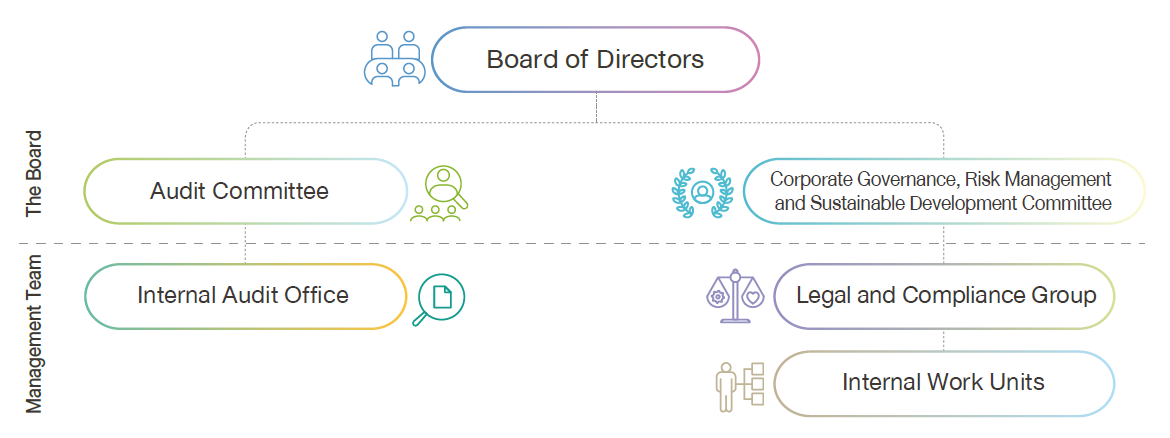
The Board
The Board of Directors is responsible for setting the direction and approving the Company’s risk management policy, as well as monitoring performance of the implementation of such policy, to ensure that the Company identifies, assesses, and manages risks comprehensively and appropriately so that risks remain at an acceptable level. In this regard, the Board of Directors has appointed the Corporate Governance, Risk Management and Sustainable Development Committee to oversee and review the Company’s overall risk management in accordance with the ERM Framework, the risk management strategies, and the risk early-warning system for all types of risks.
The Audit Committee is responsible for reviewing and ensuring that the Company has an appropriate, adequate, and effective internal control system and internal audit system, including considering the independence of the Internal Audit Unit, as well as reviewing the mission, scope of work, and the development and training plans for internal audit personnel to ensure that their knowledge and capabilities align with changes in the business environment, the Company’s operating direction, and international standards. Moreover, the Audit Committee is responsible for considering and approving the annual internal audit plan.
The Corporate Governance, Risk Management and Sustainable Development Committee is responsible for considering and approving the Company’s risk management plan, as well as overseeing and reviewing the Company’s overall risk management across strategic, risk management system, and risk early-warning dimensions, covering all types of risks, including climate change risk and occupational health and safety risk, to ensure that risk management remains within an acceptable level and is aligned with the Company’s risk management policy. In addition, the Corporate Governance, Risk Management and Sustainable Development Committee is responsible for monitoring and evaluating the implementation of the risk management plan, including the results of stakeholder management, and reporting to the Board of Directors on the status of significant risks and the implementation of risk mitigation measures.
The Management Team
The Legal and Compliance Group is responsible for establishing the context, assessing risks, and monitoring and reviewing risks at the Company level, in alignment with the principles of good corporate governance, relevant standards, and the Company’s strategies through coordination with relevant work units, namely the Safety and Quality Group and the Internal Audit Office, to integrate the risk management process across the organization, as well as reporting on risk management results to the Corporate Governance, Risk Management and Sustainable Development Committee and the Board of Directors.
The Internal Audit Office is responsible for coordinating with the Safety and Quality Group to gain an understanding of risks and the prescribed risk management measures, as well as conducting internal audits in accordance with a risk-based audit approach to assess the adequacy and effectiveness of the internal control system and the enterprise risk management process, to comply with relevant risk management standards and guidelines. The Internal Audit Office reports audit results and provides recommendations to the Audit Committee to ensure that the organization’s risks are managed to remain at an acceptable level.
The Quality Management Committee, comprising the Managing Director, Deputy Managing Directors, and Assistant Managing Directors (Safety and Quality Group), is responsible for overseeing and reviewing the business-level risk context and risk measures, by systematically integrating the risk management process into the Company’s management and internal work processes, establishing the risk management framework and processes, and considering risks across various dimensions, namely strategic, financial, operational, and project risks, as well as analyzing root causes of risks and assessing potential impacts on business operations should such risks materialize. The scope of risk consideration covers significant risks, such as emerging risks from new technologies or data integration and use, readiness for business disruption, including risks relating to climate change, human rights, personal data protection, and fraud or non-transparent operations, which may affect the Company’s business operations, etc.
The Safety and Quality Group is responsible for preparing, maintaining, and continuously improving the enterprise risk management process, and for providing advice, oversight, monitoring, and coordination with relevant work units to ensure that operations are carried out in accordance with the enterprise risk management process and that operational risks are controlled to stay at an acceptable level, as well as studying, monitoring, and assessing external environmental factors under the STEEP framework, namely social, technological, environmental (including climate change), economic, and political factors that may affect the Company’s business operations; and communicating and providing early warnings of such information to relevant work units for review of the risk context and the determination of appropriate risk treatment measures.
Risk Management Process
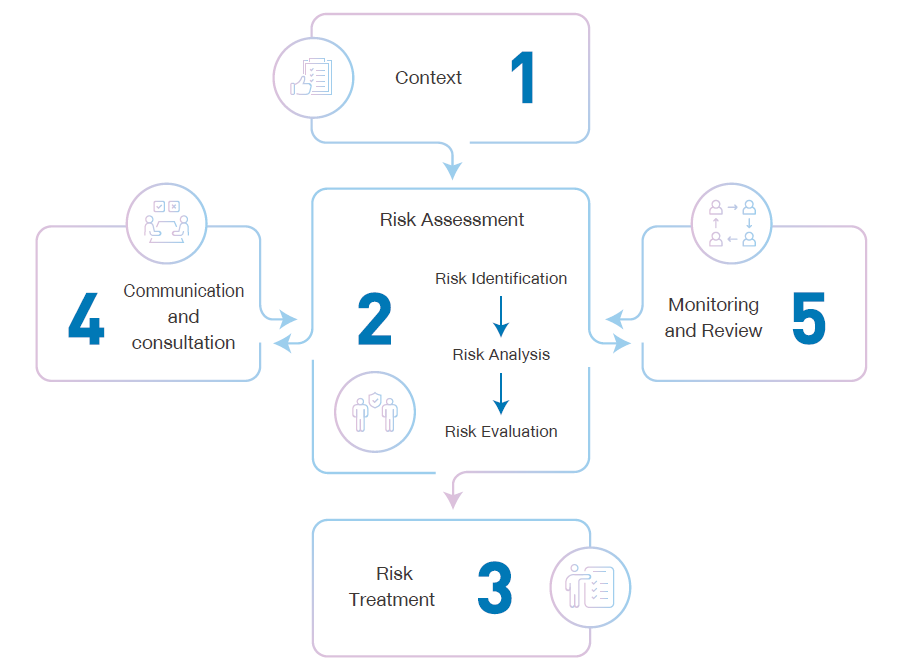
To ensure that the Company’s risk management is efficient and risks remain within an acceptable level, the Company has established its risk management process as follows:
Establishing the Context: Identifying an overall picture of the Company, the internal and external environment, key core processes, and significant changes that may affect business operations, as well as future operational policies and plans.
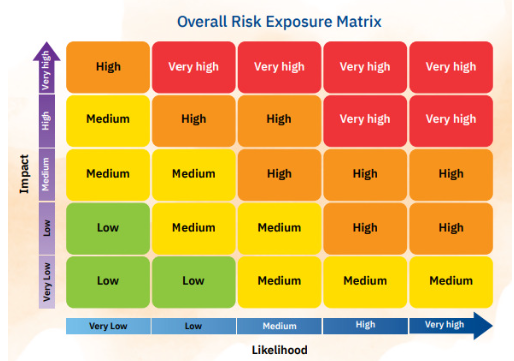
Risk Assessment: This includes risk identification, considering both internal and external environments or factors, to analyze and assess risks based on the level of likelihood of occurrence (Likelihood), the level of impact should the risk occur (Impact), and the overall level of risk (Risk Exposure). In this regard, the Company has integrated environmental, social and governance (ESG) risk criteria as part of the enterprise risk assessment process and risk prioritization, using a risk map that categorizes risks into four levels: very high, high, moderate, and low.
Risk Treatment: The Company has established risk treatment measures and Key Risk Indicators (KRIs) to reduce risks so that residual risk remains within an acceptable level consistent with the Company’s risk appetite. The Company also has a process to continuously monitor external conditions and trends across five dimensions under the STEEP analysis framework.
Communication and Consultation: This involves discussions among relevant parties on matters relating to the context and risks to obtain information and feedback, as well as to enhance knowledge and understanding of risks, enabling well-rounded, accurate, and appropriate decisions on risk treatment.
Monitoring and Reviewing: The Company monitors the implementation of the established risk treatment measures to ensure that such measures are effective and that risks are managed to stay at an acceptable level. The Company requires an annual risk review, including continuous monitoring and review of risks and relevant measures, together with communication and consultation (Continuous Improvement).
Risk Management Culture
The Company has formulated a risk management policy by integrating risk management into its management and operating processes to ensure consistent direction and alignment across the entire organization. Risk management is a shared responsibility of personnel at all levels, from employees to executives, with the main goal of supporting each work unit’s operations in achieving the stated objectives and goals. To this end, personnel within each work unit participate in Risk and Control Self-Assessment (RCSA), under which they collaboratively evaluate the effectiveness of controls relating to operations, financial reporting, and compliance with laws, rules, and regulations, and analyze risks that may have an impact on the achievement of the objectives in various aspects, to improve the existing control processes or control activities to ensure their greater efficiency and effectiveness. In addition, the Company reviews and, where appropriate, reduces control activities that may cause delays, are inefficient, or are not cost-effective, provided that they do not create additional risks due to reducing internal controls. The Company regularly reviews risks within each work’s scope of responsibility and disseminates its work rules under the enterprise risk management process to all staff for their acknowledgment and compliance, as well as enhancing its personnel’s knowledge and understanding of risk management through annual staff training courses.
In this regard, the Company prepares an annual risk management plan and establishes relevant operational regulations and documentation for risk management to serve as operational guidelines, and the Company regularly monitors, evaluates, and reviews risks to ensure alignment with changing internal and external circumstances, including developing a contingency plans for emergencies and crises, as well as a business continuity management plan to handle various situations. These plans are intended to enable the Company to take immediate corrective actions and coordinate with relevant work units at all times in the event of an emergency or crisis.
Policy Document Link
https://sustainability.bemplc.co.th/Rcm
Page Number in Report
2
Risk Factors — Overview
Risk Factors — Introduction
The risk factors that may significantly impact the achievement of the company's business objectives are as follows:
Risks to the Company's Business Operations
Risk Register
| Risk Name | Risk Characteristics | Consequences | Management Measures | Related Risk Factors |
|---|---|---|---|---|
| Risks from Business Operations under Concession Agreements with Government Agencies | The business operations under concession agreements with the Expressway Authority of Thailand (EXAT) and the Mass Rapid Transit Authority of Thailand (MRTA), both of which are under the supervision of the Ministry of Transport, may entail risks arising from changes in government policy or political instability that could lead to changes in administration or the political leadership responsible for oversight may result in changes to relevant policies, laws, and regulations, which could affect terms and conditions already stipulated in the concession agreements. EXAT or MRTA may be unable to comply with their obligations under the agreements or may request that the Company perform additional work beyond the agreed scope of the concession agreements or related arrangements. Moreover, differences in the interpretation of terms and conditions of the concession agreements between the Company and government agencies, for example, regarding responsibility for certain categories of costs, may give rise to contract interpretation disputes due to different views on contractual performance. |
|
| 730 · Description: Government policy · Info category: STRATEGIC_RISK |
| Biodiversity Risk | The Company is currently constructing the MRT Orange Line Project (Taling Chan - Thailand Cultural Centre Section). MRTA, as the project owner, has prepared an Environmental Impact Assessment (EIA) covering the overall project. The EIA concludes that impacts on biodiversity are low, and appropriate preventive measures have been established for both the construction phase and the operational phase. |
|
| 1717 · Description: ESG risk · Info category: STRATEGIC_RISK |
| Human Rights Compliance Risks Across All Stakeholder Groups | The Company’s business operations involve a wide range of stakeholder groups across the value chain, which may give rise to risks of non-compliance with human rights principles if the Company’s policies, governance, or implementation are not sufficiently comprehensive. Such risks may relate to the fair treatment of employees and workers, occupational safety and health, protection of customers’ and service users’ personal data and privacy rights, as well as impacts on communities and society arising from the Company’s business operations. Furthermore, the Company may face risks arising from the operations of suppliers and business alliances if they fail to comply with applicable laws and human rights standards. |
|
| 1717 · Description: ESG risk · Info category: STRATEGIC_RISK · 753 · Description: Impact on human rights · Info category: OPERATIONAL_RISK |
| Risk from Community Conflicts | The Company’s expressway business, rail business, and commercial development activities are closely connected with local communities, as the physical alignment of expressway and rail routes passes through urban areas and various communities, including the Company’s provision of advertising and public relations media services in multiple locations. The Company’s operations, whether during construction, maintenance, or service delivery, may affect local communities or give rise to complaints, which in some cases may escalate into disputes. |
|
| 1717 · Description: ESG risk · Info category: STRATEGIC_RISK |
| Corruption and Bribery Risks | The Company is committed to conducting its businesses in a transparent and fair manner, free from fraud and corruption at every stage of its operations. To that aim, the Board of Directors has established anti-corruption policies and guidelines for adoption as guidelines for directors, executives, and staff in the performance of their duties. Furthermore, the Company operates under the principles of good corporate governance, transparency, supported by an appropriate and adequate internal control system, well-defined operational procedures, organizational planning and work systems, as well as efficient and effective risk management measures. These practices help contribute to the Company’s achievement of its objectives, reduction and prevention of potential risks and losses from its business operations. The Internal Audit Office is in charge of reviewing operating systems across various functions and reporting directly to the Audit Committee to ensure that work operations are efficient and effective and that fraud, corruption, and bribery can be controlled and prevented. Nevertheless, risks may arise in operational processes, such as the receipt or provision of improper benefits in exchange for commercial or business advantages, or employees demanding benefits from suppliers, which may lead to misconduct in procurement processes, including payment of bribes or other benefits to government officials to facilitate work operations or obtain approvals outside normal procedures. |
|
| 741 · Description: Systems or internal control system · Info category: OPERATIONAL_RISK · 1717 · Description: ESG risk · Info category: STRATEGIC_RISK · 754 · Description: Corruption · Info category: OPERATIONAL_RISK |
| Risks from Major Accidents, Public Unrest, or Natural Disasters | The Company’s business operations, both in relation to construction and the operation and management of expressways and rail systems, are exposed to risks from external events or factors that may suddenly result in force majeure incidents, such as natural disasters, serious accidents, earthquakes, as well as terrorism or sabotage, including bombings, riots, and demonstrations by unrest groups. Such events may adversely affect business continuity, assets, revenue, and the safety of service users and personnel. |
|
| 1719 · Description: Climate change and disasters · Info category: STRATEGIC_RISK |
| Risk Relating to Workforce Capability and Insufficient Service Capacity for Business Expansion and Operations | According to government policies that prioritize addressing mobility and traffic congestion in Bangkok, the expansion of rail routes has been promoted to enhance convenience and accommodate growing ridership demand. The Company has continued to obtain additional concessions for train operations and maintenance across multiple lines, with further expansion expected in the future. Accordingly, the Company must continuously develop employees’ knowledge and capabilities, while also recruiting and selecting a significant number of personnel with appropriate knowledge, expertise, and experience in order to support business growth and operational continuity. Personnel are regarded as a key driver of the Company’s success. In this regard, the Company manages the risk of a shortage of qualified personnel through recruitment and selection processes, as well as the development and retention of employees with knowledge, capabilities, experience, and positive attitudes, to efficiently support business expansion. |
|
| 738 · Description: Reliance on employees in key positions · Info category: OPERATIONAL_RISK · 739 · Description: Shortage or reliance on skilled workers · Info category: OPERATIONAL_RISK · 742 · Description: Human error in business operations · Info category: OPERATIONAL_RISK |
| Risk from Engagement of Outsourced Experts as Main Contractors for Supply and Maintenance of the M&E Equipment | The Company has entered into contracts with external contractors for the procurement of M&E Equipment and for the maintenance of key M&E Equipment for the rail system. Accordingly, if such external contractors are unable to perform the services in accordance with the contracts, or if there are changes to the terms and conditions of the maintenance agreements, this may adversely affect the continuity of the Company’s operations. |
|
| 740 · Description: Shortage or fluctuation in pricing of raw materials or productive resources · Info category: OPERATIONAL_RISK · 734 · Description: Reliance on large customers or few customers · Info category: STRATEGIC_RISK · 735 · Description: Reliance on large partners / distributors or few partners / distributors · Info category: STRATEGIC_RISK · 745 · Description: Loss or damage from non-compliance of partners or counterparties · Info category: OPERATIONAL_RISK |
| Risk Relating to Structural Stability and Safety | Risk of deterioration, damage, or collapse of rail system structure, which may arise from two key factors, as follows:
|
| The Company has established both proactive and reactive measures to control the likelihood of occurrence and to mitigate potential impacts, as follows: 1. Engineering and Design Standards
2. Monitoring and Inspection Measures
3. Business Continuity Measures
4. Risk Transfer through Comprehensive Insurance Coverage
| 750 · Description: Climate change and disasters · Info category: OPERATIONAL_RISK |
| Risk Relating to Information System Security and Cyber threats | In an era where information technology and digital systems play a critical role in operations, the Company continuously deploys information systems to support its operations and service delivery, covering those that are essential to the Company’s core missions, such as toll collection systems, traffic control systems, and rail systems. The Company also stores and processes a substantial volume of personal data and key business information. However, cyber threats are becoming increasingly complex and severe and continue to rise, both from external and internal sources. In addition, the risk of information system disruptions and security vulnerabilities may be exploited as pathways for unauthorized system intrusions, malware attacks, or other security incidents, that may render systems or equipment unavailable, thereby causing service interruptions or delays, and adversely affecting operational continuity, revenue, service safety, and the long-term confidence of stakeholders. |
|
| 744 · Description: Information security and cyber-attack · Info category: OPERATIONAL_RISK · 1720 · Description: System disruption risk · Info category: OPERATIONAL_RISK |
| Risk Relating to Occupational Health and Safety | The Company gives priority to conducting its businesses with its commitment to ensuring the safety of expressway users, passengers, employees, contractors, and relevant stakeholders, by applying an occupational health and safety management system in accordance with the international standard ISO 45001 as a guiding framework for its operations. Moreover, in implementing the project of design and installation of rail systems, the Company has complied with EN 50126 (Railway Applications: The Specification and Demonstration of Reliability, Availability, Maintainability and Safety (RAMS)) to ensure that the rail system meets safety requirements prior to the commencement of services on the MRT Purple Line and the MRT Blue Line Extension. The Company maintains a systematic and ongoing process for managing occupational health and safety risks, covering hazard identification and reviews of risks arising from the business operations of both employees and contractors, with a view to keeping such risks at an acceptable level. In doing so, the Company takes into account relevant considerations, for example, infrastructure, the nature of activities, human factors, organizational structure, applicable requirements and laws, including the broader economic and social context. In this regard, the Company promotes employee participation in reporting and reviewing risks that may arise from changes in internal and external contexts, while also continuously communicating to build occupational health and safety awareness and to foster a safety culture among employees, contractors, and key stakeholders. |
|
| 749 · Description: Safety, occupational health, and working environment · Info category: OPERATIONAL_RISK |
| Risk from Severe Infectious Disease Outbreaks in Metro system | Outbreaks of severe infectious diseases, both domestically and internationally, particularly in Bangkok and its vicinity, may spread easily and rapidly, or infected persons may use rail services and enter rail areas, thereby affecting staff availability for service delivery, service quality, passenger confidence, and the Company’s revenue, as well as increasing costs associated with incident management. |
|
| 749 · Description: Safety, occupational health, and working environment · Info category: OPERATIONAL_RISK · 1722 · Description: Pandemic risk · Info category: OPERATIONAL_RISK |
| Risks from Non-Compliance with Laws / Concession Agreements | As a listed company that operates businesses under concession agreements with government authorities, the Company may face risks of non-compliance with applicable laws, rules, regulations, notifications, criteria, or requirements imposed by relevant regulators in connection with its business operations, or risks of failing to fully and timely comply with its concession agreements. Such risks may arise from changes in laws and regulations, misinterpretation of applicable laws, the absence of clear operational policies or procedures, inadequate internal controls, or non-compliance with requirements imposed by business counterparties. |
|
| 756 · Description: Change in laws and regulations · Info category: COMPLIANCE_RISK · 758 · Description: Violations of laws and regulations · Info category: COMPLIANCE_RISK · 759 · Description: Corporate Governance · Info category: COMPLIANCE_RISK · 1723 · Description: Legal risk · Info category: COMPLIANCE_RISK |
| Risk Relating to Revenues Below Projections | The Company provides both expressway and metro services, with its core revenues derived from expressway tolls, fares and commercial development. These revenues may be affected by external factors beyond the Company’s control, such as expansion of the rail network, competition from other transport modes, traffic conditions, fuel prices, real estate expansion, the number of tourists, outbreaks of serious infectious diseases, and changes in people’s lifestyles that affect the volume of the Company’s service users. Moreover, the Company’s commercial development revenue may fluctuate depending on domestic and international economic conditions, the competitive conditions in the advertising media and retail space lease business, as well as the operating hours of retail shops within station areas. If the Company’s revenues differ from projections, this may affect liquidity management and its ability to meet its payment obligations to the lending financial institutions or creditors. |
|
| 729 · Description: Behavior or needs of customers / consumers · Info category: STRATEGIC_RISK · 1725 · Description: Income volatility · Info category: FINANCIAL_RISK |
| Risk Relating to Interest Rate and Foreign Exchange Rate fluctuations | The Company has interest-bearing debt obligations to its lenders and is in the process of making investments that require substantial long-term borrowings. As a result, interest expenses represent a material financial cost. If interest rates are volatile or rising, this may adversely affect the Company’s financial costs and operational results. With respect to foreign exchange risk, the Company has no borrowings denominated in foreign currencies. However, certain expenses are denominated in foreign currencies, such as maintenance costs for M&E Equipment for the MRT system and certain portions of insurance premiums. If the Thai Baht depreciates, the Company’s costs may increase accordingly. |
|
| 764 · Description: Fluctuation in exchange rates, interest rates, or the inflation rate · Info category: FINANCIAL_RISK |
| Flood Risk from Climate Change | Increasingly severe climate change may give rise to natural disasters, in particular flooding resulting from the continued rise in sea levels, which could affect Bangkok, its vicinity, and low-lying areas where expressway on- and off-ramps and MRT station entrances and exits are located. Such impacts may require the suspension of operations or adjustments to the mode of operations, thereby affecting the efficiency, convenience, and safety of expressway and metro services. This may also reduce revenue due to a decline in the number of expressway users and MRT passengers. At the same time, management costs may increase as a result of higher operating, maintenance, security, and facilitation expenses, as well as rising costs of goods, services, and transportation, and costs associated with compliance with government measures. |
|
| 1717 · Description: ESG risk · Info category: STRATEGIC_RISK · 1719 · Description: Climate change and disasters · Info category: STRATEGIC_RISK |
| Technology-related risks | The adoption of digital technologies, including Artificial Intelligence (AI), automation systems, and Generative AI (GenAI), in business operations enhances efficiency and competitiveness. However, it may give rise to risks such as Algorithmic Bias, inaccuracies or lack of transparency in automated system decisions, cybersecurity risks, as well as unexpected impacts from AI system operations, including the use of technology as a tool for cyber threats. This could affect data accuracy, business continuity, stakeholder confidence, and the organization's image. The company recognizes the importance of managing technology-related risks. It has established a governance framework, information security controls, data and technology risk management, oversight of external service providers, as well as continuous development of personnel knowledge and awareness. This is to ensure that the adoption of technology is appropriate, compliant with laws and good governance principles, and remains within acceptable risk levels. |
|
| 732 · Description: Changes in technologies · Info category: STRATEGIC_RISK · 744 · Description: Information security and cyber-attack · Info category: OPERATIONAL_RISK · 1720 · Description: System disruption risk · Info category: OPERATIONAL_RISK |
| Risk from the Enforcement of Climate Change-Related Laws | Climate change is a key factor affecting business sustainability in both the short and long term. In particular, a regulatory body, i.e., the Office of the SEC, has currently announced an enhancement of sustainability disclosure standards aligned with the International Sustainability Standards Board (ISSB) standards (IFRS S1 and S2), which will apply to listed companies in the SET50 group starting from the 2027 fiscal year and will cover all listed companies by 2030. Such requirements will result in a significant increase in the Company’s duties and responsibilities in preparing sustainability disclosures, including the Sustainability Report and the 56-1 One Report, which must systematically link climate-related risks to financial impacts under four pillars: Governance, Strategy, Risk Management, and Metrics/Targets (Scopes 1, 2, and 3). This may lead to additional costs for the Company relating to data management and assurance by auditors or independent verifiers, as well as credibility risks if the Company is unable to achieve publicly disclosed targets. In addition, the Company continues to monitor the progress of Thailand’s draft Climate Change Act currently under development, which may introduce additional mandatory legal mechanisms in the future, such as mandatory reporting measures to government agencies, the imposition of a carbon tax, or an Emission Trading Scheme (ETS). Accordingly, the Company needs to expedite improvements to its work processes and ensure systematic retention of reports to reduce non-compliance risk and maintain competitiveness under a future low-carbon economic context. |
|
| 756 · Description: Change in laws and regulations · Info category: COMPLIANCE_RISK · 758 · Description: Violations of laws and regulations · Info category: COMPLIANCE_RISK |
Risks to Securities Holders' Investment
Risk Register
| Risk Name | Risk Characteristics | Consequences | Management Measures | Related Risk Factors |
|---|---|---|---|---|
| Risk from Uncertainty of Expected Returns of Investors | The Company conducts its operations with due regard to shareholders’ interests. However, the Company’s share price may increase or decrease depending on various factors beyond the Company’s control in respect of economic conditions, abnormal global situations, such as serious disease outbreaks or war, as well as government policies and changes in applicable policies, laws or conditions. All these factors result in a decrease and/or increase in the share price; and therefore, investors may face the risk that the returns they receive will not meet their expectations. |
|
| 768 · Description: Return from investment of securities holder · Info category: HOLDER_RISK |
| Risk from Dividend Payments Not Meeting Investors' Expectations | The Company’s ability to pay dividends depends on its operational results, net profit and annual cash flows, financial structure and commitments, as well as investment requirements. If other factors adversely affect the Company’s dividend-paying capacity, investors may face the risk of receiving annual or interim dividends at a dividend rate lower than what they expect. However, the Company has a dividend policy to pay dividends of not less than 40 percent of net profit for each year, by taking into account the operational results, financial structure and commitments, as well as investment requirements, along with consistency in payment of dividends to its shareholders. |
|
| 768 · Description: Return from investment of securities holder · Info category: HOLDER_RISK |